Automotive
Speed to Lead for Car Dealerships: Why the First Real Answer Wins the Deal
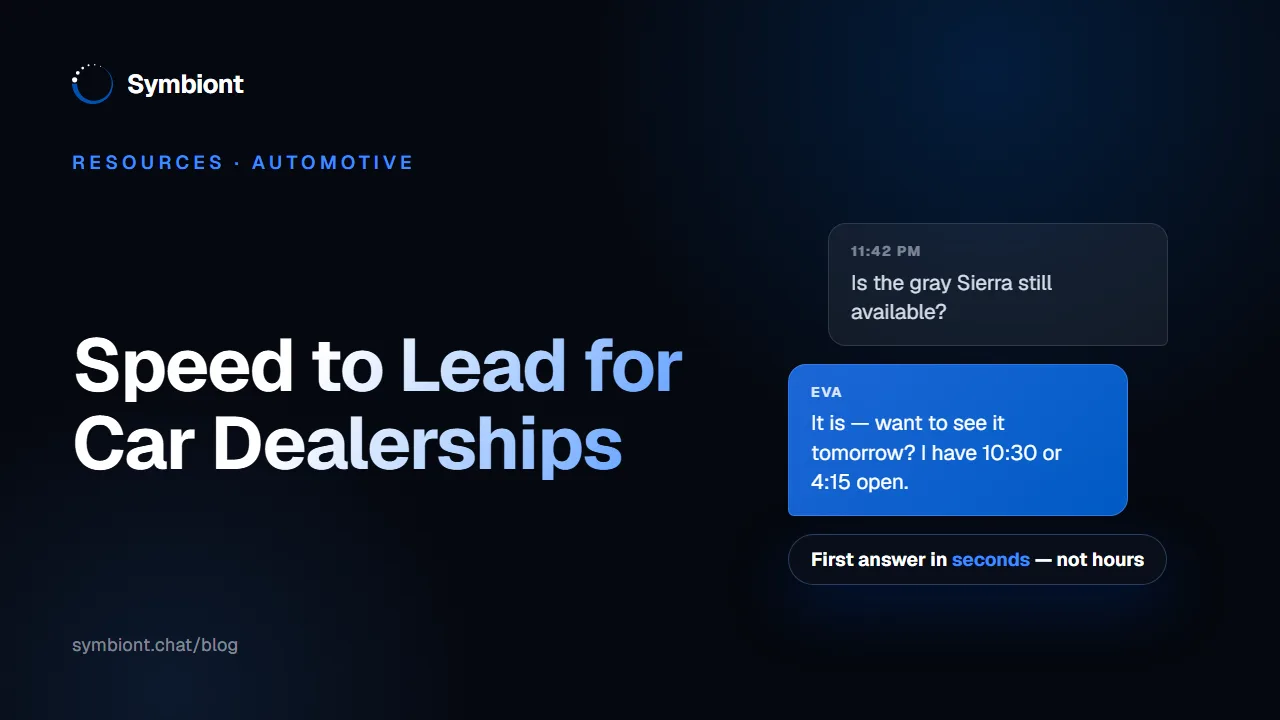
Speed to lead for car dealerships is how fast your store puts a real answer in front of a shopper who just reached out, and the winning standard is now seconds, around the clock, because internet shoppers inquire at several stores in one sitting and work with whichever one answers first. I spent nine years in dealership operations before I co-founded Symbiont, and the stores I watched win never had the biggest lead count. They had the fastest first answer.
Automotive makes that math unforgiving. The shopper who just submitted a lead on your Tahoe can find the same truck, at a similar price, twenty minutes down the road, and they often submit a lead to that store in the same sitting. Whoever answers first sets the agenda: the appointment, the trade conversation, the deal structure. Everyone else is calling a shopper who already has plans.
This article is for dealers, GMs, and BDC managers who pay for internet leads and lose too many of them to slow replies. It covers what speed to lead means in a dealership, what response times across the industry actually look like in 2026, and how to answer in seconds without adding headcount.
What does speed to lead mean for a car dealership?
Speed to lead is the time between a shopper raising a hand (a website chat, a form on a vehicle page, a third-party lead) and your store giving a real answer. For a dealership it is measured in seconds and minutes, not hours, and the clock starts the moment the shopper engages, not when the lead finally surfaces in the BDC queue.
A reply is not an answer. The templated "Thanks for your interest in the 2024 Silverado!" email moves nothing. Confirming the truck is on the lot, ballparking a payment, or offering a Saturday test drive does.
Why does speed to lead matter more in automotive than almost anywhere?
Because your inventory is rarely unique. The same vehicle, or a close substitute, sits on a competitor's lot at a comparable price, and internet shoppers often send inquiries to several stores in one sitting. The store that answers first earns the appointment. The rest end up working a shopper who has already anchored on someone else's number.
The decay curve is well documented. In research published in Harvard Business Review, James Oldroyd and his co-authors audited 2,241 companies and found the average first response to a web lead took 42 hours, and that companies making contact within an hour were about seven times likelier to qualify the lead than those waiting just an hour longer, and more than sixty times likelier than those waiting a full day. The window is a cliff, not a slope. It is not unique to cars, either: we see the same pattern in speed to lead for pool companies, another high-ticket, heavily shopped purchase.
What do dealership response times actually look like in 2026?
Dealerships are answering faster than they ever have, and a meaningful share still are not answering at all. Pied Piper's 2026 Internet Lead Effectiveness study mystery-shopped 3,290 dealership websites with an inquiry about an in-stock vehicle and measured the following 24 hours. Just over half of dealerships, 51%, scored above 80 (a quick, thorough, personal response) while 14% scored below 40, meaning they failed to personally respond to their own website customers at all.
The OEMs are watching the same scoreboard. The study ranks brands by dealer responsiveness (Infiniti led 2026 with an average score of 82 against an industry average of 71), so a slow store is not just losing deals, it is dragging its brand's numbers.
The study also flagged a newer failure mode. Stores increasingly let automated tools handle the first reply, and when those tools needed a human to follow through, customers were twice as likely to end up with no personal response at all. Automation that opens a conversation and then drops it is not speed to lead. It is a slower way to lose the same lead.
How many dealership leads arrive after hours?
About half of dealership leads arrive outside weekday business hours, so lead flow peaks almost exactly when the BDC goes home. Which evenings carry the volume, what happens to those leads overnight, and what Sunday closing laws change are covered in stop losing after-hours car dealership leads.
How fast is fast enough for an internet lead?
Fast enough means an answer while the shopper is still on your site: seconds, not the 15-minute targets many BDCs chase. The widely cited five-minute rule from the classic Lead Response Management Study is a floor, not a goal: by the time a lead routes through the CRM and the round-robin fires, an after-hours shopper has two more dealer tabs open.
The bar has moved twice. "We call every lead back within a day" stopped being competitive years ago. Now even "we respond in minutes during business hours" leaves the after-hours half of your leads waiting overnight. The standard that wins is an instant, useful answer at 11 p.m. on a Tuesday.
How can a dealership answer in seconds, 24/7?
Put a salesperson on the website who never clocks out. Eva by Symbiont is an AI assistant built for car dealerships: she reads intent (hard questions, vague prompts, not just keywords), answers inventory, trade, and financing questions in seconds, in 50+ languages, guides the search with live match counts, and takes the test-drive request, day and time included, while the shopper is still on the page, around the clock.


Eva also gives a high-intent shopper something a callback never can: a next step they can take right now. With Build my deal, a shopper customizes their deal (down payment, term, and more) from a banner on the vehicle page or right in chat, then leaves an email or phone number to get pricing. Shoppers can pick vehicles and compare them on the metrics they care about, with the comparison emailed to them, or run a broad search and have Eva narrow it by features, miles, color, and price. Every one of those is a captured, named lead.
The results are measurable. At Coast Buick GMC, a dealership we serve, Symbiont adds about half a point to a point of website lead conversion on top of what the store's forms already produce, 8 in 10 of those leads arrive through Build my deal, and the average buyer spends over five and a half minutes building the deal. Not more conversations. More leads your desk can work.
Does AI speed to lead replace your BDC?
No. It protects your BDC's mornings and your salespeople's floor time by handling the first response, the after-hours load, and the repetitive questions, then handing real buyers to people. Eva is built with two-way live intercept: your team can watch any conversation in real time and jump in whenever they want, and when a shopper asks for a person, the handoff carries the full conversation with it.
That handoff is exactly where the Pied Piper study found automation breaking down: answered first messages, dropped follow-through. The fix is not less automation, and it is not a night shift. It is an instant first response that escalates cleanly, so the 9 a.m. call your BDC makes is to a shopper who already built their deal the night before.
Frequently asked questions
What is speed to lead at a car dealership?
It is the time between a shopper reaching out (a website chat, a form on a vehicle page, a third-party lead) and the dealership giving a real answer. Fast, specific first responses win appointments because shoppers often submit leads to more than one store and engage with whoever replies first.
What is a good lead response time for an internet lead?
Minutes at the outside. Research published in Harvard Business Review found companies that made contact within an hour were about seven times likelier to qualify a lead than those an hour slower. The stronger standard is seconds: answer while the shopper is still on your website, before they cross-shop.
Why do dealerships lose internet leads after hours?
Because lead volume and staffing run on opposite schedules. Around half of dealership leads arrive outside weekday business hours, after the BDC has gone home, so the first response slips to the next morning. By then an after-hours shopper has often already booked an appointment with a store that answered instantly.
Can an AI assistant really book test drives?
It can take the request. Eva answers inventory, trade, and financing questions in seconds, reads the shopper's intent instead of matching keywords, and lets the shopper pick a day and time for the test drive while they are still on the site; the request reaches your team with the full conversation attached, so your team confirms it already knowing the deal.
Does instant AI response replace the BDC?
No. Eva handles the first response and the after-hours load, then hands real buyers to your people. Your team can watch every conversation live and step in anytime with two-way intercept, so a shopper who wants a person gets one without starting the conversation over.
Ready to answer every internet lead in seconds?
See it on your own inventory. Get a Demo and watch Eva answer shoppers, build deals, and capture test-drive requests in seconds; then see everything she does for dealerships at Symbiont for automotive.
How many of last night's leads got their first real answer this morning?