Automotive
How Coast Buick GMC Turns Website Traffic Into Buyer-Built Deals
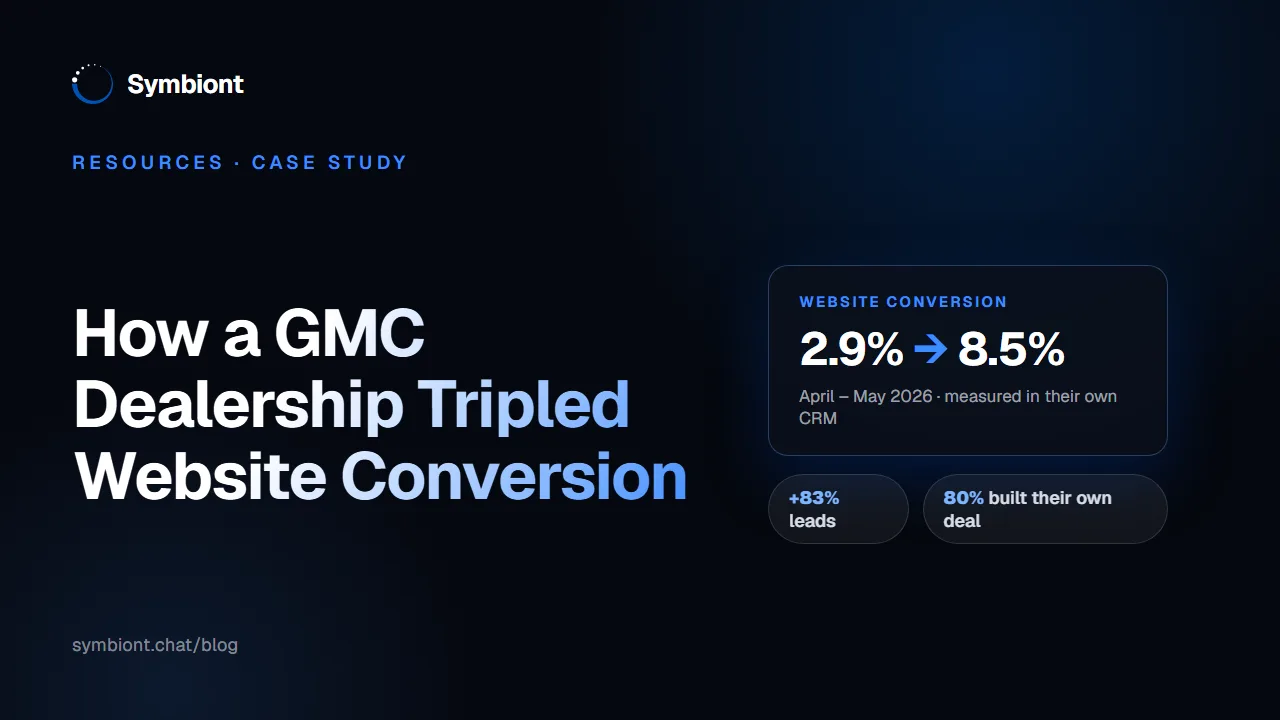
Coast Buick GMC, a dealership we serve, gets a new kind of lead from its website: a shopper who picked the vehicle, set the down payment and term, and spent over five and a half minutes building the deal before anyone at the store knew their name. Those leads come on top of what the store's forms already produce, at roughly half a point to a point of the site's monthly traffic. This post is how that works, what the numbers mean, exactly where they come from, and what transfers to other stores.
I spent nine years in dealership operations before co-founding Symbiont, so I will tell it the way I would want it told to me.
What problem was the dealership trying to solve?
The dealership's problem was traffic that never identified itself. Shoppers arrived, browsed inventory, sometimes opened the chat, and left without a name, a number, or a next step. The store was not short on visitors. It was short on visitors who turned into someone the sales team could call.
That is the normal condition of a dealer website. Ruler Analytics' benchmark data puts the automotive industry's average website conversion around 2%. Normal means roughly 98 of every 100 visitors leave without a trace, and the forms only ever catch the ones who had already decided to reach out.
Why wasn't chat alone enough?
Because shoppers would not open it, and the ones who did would not stay. We went live on the store's website in February 2026 with what most vendors would call a finished product: a well-trained chat assistant. The results were just okay: 10 leads in March, and that number is what started the search for other ways to engage. The engagement data said why. Years of scripted widgets have taught shoppers that a chat bubble means a form with a typing animation, so most of them treated it accordingly and kept browsing.
The useful part was what they did instead. We dug into what shoppers actually did on the site and tested what they engaged with, and the answer was the deal: the payment on this vehicle, with this much down, at this term, worked out privately before talking to anyone. We had not found a tool that offered that inside the dealer's own website, integrated with the chat, without bouncing the shopper to a third-party site. So we built it. Build My Deal launched in April 2026, with a banner on the site prompting shoppers to build their deal, and that is where everything changed.
What changed?
In April 2026 we pointed Eva by Symbiont, the AI assistant already on the dealership's website, at the shoppers showing real buying signals, and gave them a reason to identify themselves that a contact form cannot offer.


- Build My Deal. From a banner on the vehicle page or right in the chat, a shopper structures their own deal: lease, finance, or cash, down payment, term, the numbers they actually care about. To get the pricing, they leave an email or phone number. That is the lead.
- The comparison funnel. Shoppers pick the vehicles they are cross-shopping, compare them on the metrics they choose, and get the comparison sent to them.
- The search funnel. A plain-language search returns matches with live counts and narrows by features, miles, color, and price.
- Intent-reading chat. Eva reads where a question is trying to go and answers from the store's inventory, specials, hours, and policies, at any hour.
None of this was custom-built for one store. It is the standard toolkit, aimed at identifying buyers instead of talking to everyone.
What does the result look like?
Two facts describe it, and neither is a vanity metric.
First, the leads are additional. Symbiont adds about half a point to a point of website lead conversion on top of what the store's forms already produce. On a site with 10,000 monthly visitors, that is 50 to 100 additional leads a month. The form keeps working exactly as before; these are the shoppers who would have left.
Second, the leads arrive built. 8 in 10 of them come through Build My Deal, and the average buyer spends over five and a half minutes in the conversation that builds it. That is a long time for a shopper to spend voluntarily on a dealer website, and it shows in what the sales team receives: not "what are you looking for?" but a pricing conversation about a deal the customer designed.
What did the lead count do, month by month?
Here is the series, from the same dashboard, counting the leads Eva captures on the store's site. The store's form leads are separate and unchanged; these are on top.
| Month | Leads Eva captured |
|---|---|
| February–March 2026 (chat only) | 10–15 a month (10 in March) |
| April 2026 (Build My Deal launches) | 18 |
| May 2026 | 33 |
| June 2026 | 17 |
| July 2026 | 34 |
| August 2026 | 25 |
Two honest notes on reading it. June is a seasonally slow month for Florida automotive, and everything at the store moved down with it; that is what one store's raw counts look like, which is why the caveats below matter. And the level shift is the point, not any single month: 10–15 a month on chat alone became an average of about 27 with the funnel, with the best months over 30, and 8 in 10 of those leads arriving through Build My Deal.
What does a buyer-built deal mean for the sales team?
It means the lead arrives mid-funnel instead of top-of-funnel. A shopper who used Build My Deal has already picked the vehicle, set a down payment, and chosen a term. The first call is not discovery. It is a pricing conversation, and the customer opened it.
Anyone who has worked a lead bucket knows that difference. A cold form-fill and a lead with a deal attached are not the same unit of work, even when they count the same on a report.
How are these numbers measured?
In Symbiont's analytics for the store's website: the dashboard the dealership logs into, the same one we run the business on. We do not have the store's CRM data, and we do not claim to. What we measure is what the system produces against the store's own website traffic: leads captured, how each one arrived, and how long the buyer spent. Where a figure could be read two ways, we use the lower reading.
Some honest caveats. This is one store, not a controlled study. Seasonality, inventory, and the store's own promotions all move the numbers. What the data does support: the leads are additional to the form, 8 in 10 carry a deal the buyer built, and the buyer spent minutes, not seconds, building it.
What can other dealerships take from this?
Three things transfer. First, measure identified leads against your total traffic, not engagement: if your reporting celebrates opens or conversations, you are optimizing the wrong number. Shoppers will not talk to an AI for long; they will build a deal. Second, give shoppers a reason to identify themselves: a deal they built and want priced is a reason; "leave your email and we'll get back to you" is not. Third, point your website assistant at intent, around the clock: the shoppers doing real research are on your site at 11 p.m., when nobody is on the floor.
The pattern is not unique to automotive. High-ticket buyers research the same way everywhere; we have written about the identical leak in website conversion for pool builders.
Will every store see the same lift? The result depends on your traffic, your inventory, and your process. The honest claim is narrower: if far more shoppers browse your inventory than ever leave a name, that gap is your opportunity, and a deal they can build themselves is the most reliable way we have found to close it.
FAQ: what dealers ask about this case study
How much does Symbiont add on top of a dealership's existing leads?
About half a point to a point of website lead conversion, measured against total site traffic. On 10,000 monthly visitors that is 50 to 100 additional leads a month, on top of what the store's forms already produce.
Where do the numbers come from?
From Symbiont's analytics for the dealership's website, the dashboard the store logs into. They measure what the system produces against the store's own traffic. They are not the store's CRM figures, and we do not present them as such.
What does "buyer-built deal" mean?
The shopper used Build My Deal to pick the vehicle and set the down payment, term, and payment type, then left contact details to get pricing. The lead reaches the sales team with that deal attached.
How long did it take?
Setup is fast: stores are generally live within 48 hours. Give it a month or two of real traffic to judge the lift on your own site. At Coast Buick GMC, Build My Deal launched in April 2026 and the level shift showed in the first full month.
See what your traffic is already worth
This store did not buy more traffic. It identified the buyers who were already on the site, and they showed up having built their own deals. Build My Deal, the comparison funnel, and intent-reading chat are the standard toolkit Eva runs for dealerships, not a custom build.
See the same numbers measured on your own website. Get a Demo.
How many of last month's visitors browsed your inventory and never left a name?