Comparisons
Contact Forms vs AI Chat for Pool Builders: Which One Actually Books the Job?
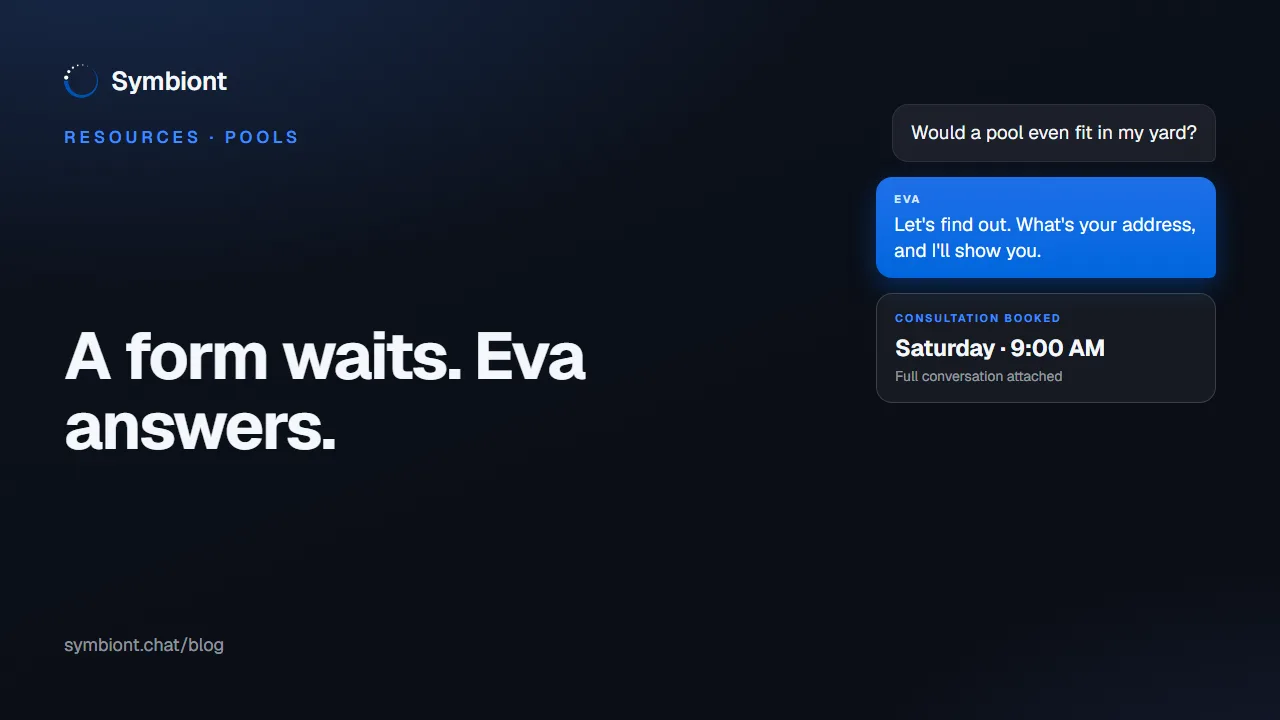
A contact form and AI chat both capture pool leads, but they work in opposite directions. A form asks the homeowner to do the work and wait for a callback. AI chat does the work in the moment: it answers the question that brought them, qualifies the project, and captures the consultation request before they leave. One hopes. The other closes.
That difference sounds small until you count what walks out. A form is a filter that only passes visitors who were already sold enough to type their details into a box and sit on their hands. Everyone else, the ones with a question first, the ones browsing at 10pm, the ones comparing you against two other builders tonight, simply leave. This is the honest head-to-head, including the places where a plain form still beats chat.
What is the real difference between a contact form and AI chat?
The real difference between a contact form and AI chat is who carries the effort. A contact form is a request: it asks a homeowner to supply information and then wait, with no answer given in return. AI chat is an exchange: it gives the homeowner something (a real answer about their project, their yard, their budget) and captures their details as a natural consequence of the conversation.
That reversal changes who converts. A form converts people who have already decided to contact you. Chat converts people who are still deciding, which on a pool builder's website is nearly everyone. Website conversion sits in the low single digits almost everywhere: Contentsquare's benchmark, drawn from 99 billion sessions, puts new visitors at 1.7 percent. Those figures skew to retail rather than to contractors, but the order of magnitude is the point, and a form is a large part of why the rest leave without a trace.
Which converts more pool leads, a contact form or AI chat?
AI chat converts more pool leads than a contact form, and the mechanism is not mysterious: it engages the visitors a form never reaches. A form is passive and waits to be found. Chat is active, opens the conversation, and holds it.
Three structural gaps account for most of the difference:
- The form asks before it gives. A homeowner researching a build worth tens of thousands of dollars has questions before they have trust. A form answers none of them and still demands their phone number.
- The form has no hours. Nearly half of high-intent inquiries arrive outside business hours, when a form can only collect and stall. The full cost of that gap is in stop losing after-hours pool website inquiries.
- The form's follow-up is a coin flip. The landmark Harvard Business Review study sent a web lead to each of 2,241 companies and found that 23 percent of them never responded at all. A form submission is not a lead until someone actually calls back.
How do contact forms and AI chat compare side by side?
Comparing contact forms and AI chat across the jobs a pool builder actually needs done makes the trade-off concrete. Neither column is all wins.
| What you need | Contact form | AI chat |
|---|---|---|
| Cost and setup | Near zero, minutes | A subscription, live in about 48 hours |
| Answers the buyer's question | No | Yes, in the moment |
| Works at 10pm on a Sunday | Collects only | Answers, qualifies, books |
| Qualifies the project | Only what the fields ask | Budget, project, property, timeline, in conversation |
| Captures the undecided visitor | No | Yes |
| Captures the consultation request | No, needs a callback | Yes, with the conversation attached |
| Detailed written spec from a decided buyer | Excellent | Good, but a form is tidier |
| Fails quietly when ignored | Yes, badly | Hands off to your team |
When is a contact form still the right choice for a pool builder?
A contact form is still the right choice in three honest cases, and any vendor who tells you otherwise is selling. Forms are cheap, universally understood, and they do one thing genuinely well.
- A decided buyer with a detailed spec. Someone who already chose you and wants to write out their yard dimensions, their must-haves, and three photo links is better served by a form field than by a conversation.
- A very low-traffic site. If your website sees a trickle of visitors and your leads come from referrals and trucks, chat has little to work with. Fix traffic first.
- As the fallback. Some people will never talk to a chat window, and a form should still be there for them.
Keeping both is the normal end state. What is not defensible is a website whose only capture mechanic is a form that answers nothing and sleeps at night.
What does AI chat do that a contact form structurally cannot?
AI chat does four things a contact form cannot do at any price, because they require a two-way exchange and a form has only one direction.
It answers, which is what earns the right to ask for a phone number at all. It qualifies in conversation, drawing out budget, project type, property, and timeline without a wall of fields; the mechanics are in how to qualify pool leads automatically. It captures the request, handing your team a qualified consultation request with context instead of creating a task for someone to chase tomorrow. And it captures the undecided, the visitor who was never going to fill out anything but will happily ask "would a pool even fit in my yard?"
A form cannot answer that question. That is the whole argument.
Where does Eva by Symbiont fit in the forms versus chat decision?
Eva by Symbiont is the AI chat side of this comparison, built specifically to convert a pool builder's own website traffic. Symbiont is the company; Eva is the assistant it builds for pool builders and dealerships, and Symbiont is a conversion system, not a chatbot. She is on-site chat: she answers in 50+ languages, qualifies, renders the pool in the buyer's own backyard in under 60 seconds, and captures the consultation request for your team. She does not make outbound calls or send drip campaigns. Symbiont does not re-route the leads your forms already get. It converts the quiet browsers who leave without converting, roughly 98 of every 100 first-time visits by Contentsquare's benchmark, by giving them something first: their own pool, rendered in their own yard. Your existing calls to action keep working exactly as they do today.


She also does something no form field has an answer for. In "Design my pool," the homeowner chooses shape, size, and features, and Eva puts the result into their own backyard, worked up from a satellite image of the address, an uploaded picture, or a photo taken on the spot. The design goes out once they leave their details. Compare that to a text box asking for a phone number: one gives the buyer something they wanted, the other asks them to gamble. The tool is covered on its own in the pool design tool guide.
The measured proof now runs in both verticals. At Coast Buick GMC, a dealership we serve, Symbiont adds about half a point to a point of website lead conversion on top of what the store's forms already produce, and 8 in 10 of those leads arrive with a deal the buyer built, measured in the dashboard the store logs into. On the pool side, Coast to Coast Pools' website converted 22% more of its visitors in the three months after Eva launched than in the three before, forms and chat counted together; the full comparison, including what happened to the form, is in the Coast to Coast Pools case study. What a builder can do is run the arithmetic on their own traffic with the incremental-lead calculator, which projects leads added on top of whatever the site converts today.
For the wider vendor landscape, the best chatbot for pool builders guide compares the real options.
Frequently asked questions
Do contact forms or AI chat produce better quality pool leads?
AI chat produces better-qualified leads, because it can ask follow-up questions a form cannot. A form gives you whatever fields you demanded, usually a name, an email, and a sentence. Chat arrives with budget, project type, property, and timeline attached, plus the whole conversation for context.
Can AI chat and a contact form run on the same website?
Yes, and most pool builders should run both. Chat catches the undecided visitor and the after-hours inquiry; the form remains for the decided buyer who wants to write out a detailed spec, and for anyone who simply prefers not to chat. The mistake is making the form your only capture mechanic.
Will AI chat annoy homeowners who would rather just fill out a form?
Only if it behaves like a pop-up. A good assistant opens with something relevant to the page, answers when spoken to, and gets out of the way when it is not wanted. Homeowners spending heavily on a build tend to want answers fast, and a chat that gives real ones is a help, not an interruption.
Does AI chat make sense for a small pool company with low website traffic?
If almost nobody visits your website, chat has little to convert and your problem is traffic, not capture. Chat earns its keep once you have visitors arriving and leaving without a trace. Cost-per-lead maths for that decision is covered in lead conversion for pool builders.
How quickly can a pool builder replace a form-only website with AI chat?
Eva goes live in about 48 hours, trained on your services, your pricing approach, and your policies. You do not rebuild the website, and you do not have to remove the existing form. The chat layer sits on top of the site you already have and starts working the traffic you already pay for.
Find out what your form is letting leave
A contact form is a hope: the hope that a homeowner will do the work, wait for a callback, and still be interested when it comes. AI chat removes the hope from the equation by answering, qualifying, and booking while the buyer is still on the page.
See how Eva answers real pool questions and captures consultation requests from the traffic you already have. Get a Demo or call 941-404-5402.