Pools
Pool Design Tools for Builders: What an In-Chat Designer Does That a Photo Gallery Can't
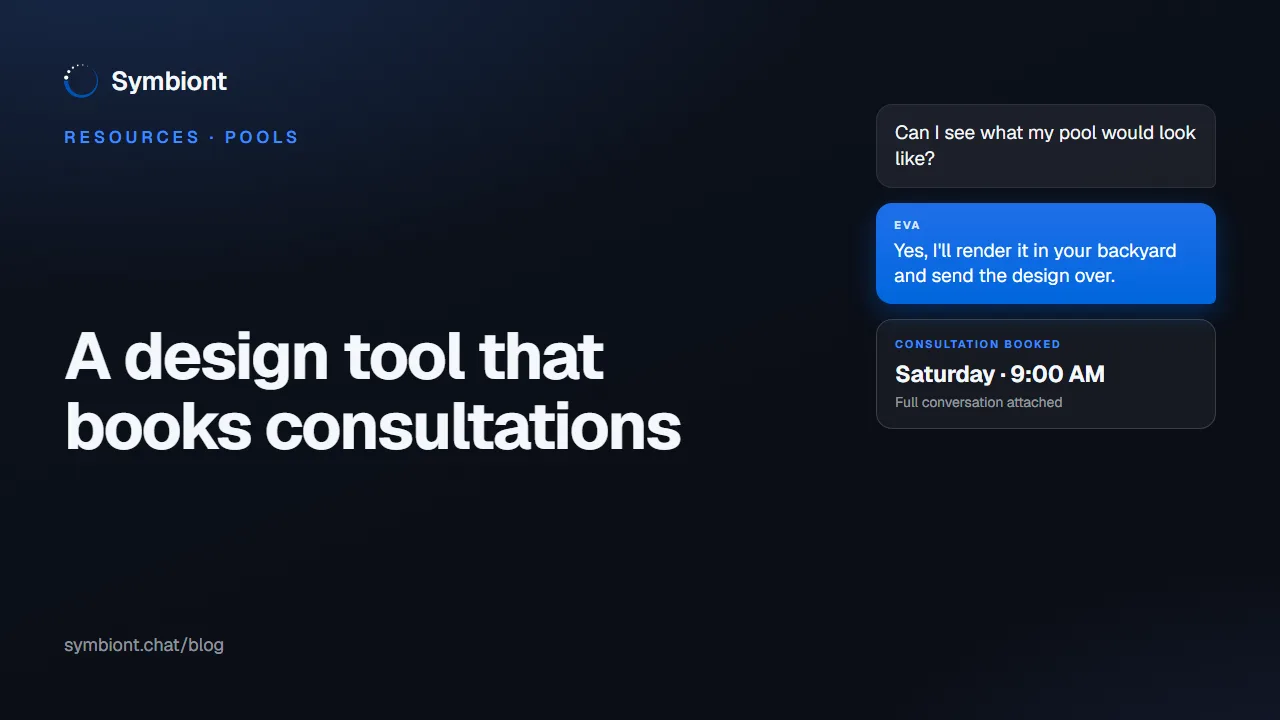
A pool design tool for builders is software on your website that lets a homeowner design their own pool, shape, size, features, then see it rendered in their actual backyard. The point on a builder's site is not a pretty picture. It is a named, qualified lead who has already pictured the pool in their yard before your phone rings.
I did not come to this from the pool trade. I spent nine years on dealership desks watching ready buyers leave because a brochure asked nothing of them. The configurator changed that. A buyer who builds the thing on screen behaves like an owner, not a browser. Pools are the same purchase, bigger ticket, longer wait.
What is a pool design tool on a builder's website?
A pool design tool on a builder's website is anything that lets a visitor shape a pool themselves instead of scrolling finished photos. The useful version does two jobs at once: it gives the homeowner a vision of their own project, and it captures who they are while their interest is at its peak.
Most tools sold to pool builders fall into two camps. One camp is design-and-estimating software your team drives in the office to produce client presentations and build documents. The other camp, where Eva by Symbiont lives, is a conversion tool that sits on your public site and turns an anonymous visitor into a booked consultation: the homeowner designs the pool, sees it rendered in their own backyard in under 60 seconds, and gets the design on their own landing page. On one builder's site we serve, about 1 in 4 rendered pools becomes a lead. Both are called "design tools," and confusing them is how builders end up paying for engineering software when the problem they actually have is leads slipping away after hours. Symbiont does not re-route the leads your forms already get. It converts the quiet browsers who leave without converting, roughly 98 of every 100 first-time visits by Contentsquare's benchmark, by giving them something first: their own pool, rendered in their own yard. Your existing calls to action keep working exactly as they do today.


How does Eva's "Design my pool" tool work for a builder?
Eva's "Design my pool" feature runs inside the chat on your website, not in a separate app your team has to learn. A homeowner describes the pool they want, shape, size, features, the feel, alongside their financing questions, and Eva produces one AI rendering of that pool composited into their real backyard.
The yard comes from one of three places: a satellite image of the address they type in, a picture they upload, or a photo they take on the spot. To get the finished design sent over, the buyer leaves their contact details. That single step is the whole reason this belongs on a builder's site: every render becomes a named lead with a specific vision attached, not an anonymous view of a gallery.
Be clear about what this is not, because over-claiming costs you credibility on the sales call. Eva does not produce 3D or CAD models, AR or live-camera walkthroughs, multiple angles, engineering plans, or an instant price on screen. It is one rendering in the real yard plus a captured lead. Pricing is sent over after contact details are in, which is what makes the contact step feel natural rather than like a tollbooth.
Why does a buyer who designs the pool act differently than one looking at a gallery?
A buyer who designs the pool values it more than one who only looks, because the effort of building it creates a sense of ownership before any money changes hands. This is the most useful piece of consumer psychology a pool builder can put to work, and it is well documented.
In the Journal of Consumer Psychology, Michael Norton, Daniel Mochon, and Dan Ariely named this the "IKEA effect": across four experiments, people placed a significantly higher value on things they had built themselves, including their own amateur work, than on identical items made by someone else. Labor on a thing turns into attachment to it. A homeowner who has chosen the shape, the tanning ledge, and the finish has done exactly that kind of labor.
The companion finding is the endowment effect. In their Journal of Political Economy study, Daniel Kahneman, Jack Knetsch, and Richard Thaler showed people demand far more to give up something they already feel they own than they would have paid to get it. Put together: a homeowner who designs their pool and sees it in their own yard already feels like the owner of that vision. Leaving a phone number to "get my design" is not friction. It is them protecting something they now consider theirs. A gallery photo, however gorgeous, asks for none of that and earns none of it.
How is Eva different from pool design and CAD software like Pool Studio or Vip3D?
Eva is not design-and-estimating software, and a builder shopping for "pool design tools" should know the difference before comparing on the wrong axis. The CAD products are tools your designers drive to build client-ready presentations and construction documents. Eva is a public-facing conversion tool whose only job is booked consultations from your website traffic. Here is an honest read of the category, each verified on the vendor's live site:
- Pool Studio (Structure Studios): purpose-built 3D pool design software your team uses to produce detailed, client-ready presentations fast. Built for designers presenting a fully rendered design to a buyer.
- Vip3D (Structure Studios): the heavier sibling, combining pool, landscape, and hardscape design with professional drafting, build-ready documents, and specs, from concept through permit-ready paperwork.
- canibuild: instant site feasibility, setbacks, utilities, and constraints, plus permit-ready site plans. Built for the guesswork of whether and where a pool can legally go.
- VirtualPools: a 3D configurator, an on-site mobile app with VR, and a website lead generator in one ecosystem. The closest of the four to the website-conversion job, bundled with full 3D design.
Each of those is a real, capable product for the job it was built for. Eva sits in a deliberately narrower lane. It does not draft plans or generate engineering documents, and it does not make renders for design's sake. It exists to turn the traffic on your pool company's website into named, qualified consultations, including the nights and weekends when nobody is at the office to drive a CAD seat. If your gap is producing polished designs in a sales meeting, buy design software. If your gap is that interested visitors leave without a trace, that is the gap Eva is built for. For the wider field, including the construction platforms and the AI visualizers, with each vendor's published price, see best pool design software for pool builders.
Does an in-chat design tool actually move the number that matters?
The number that matters to a builder is leads, not renders, and lead capture is where this kind of tool earns its place. We have direct evidence of the lead-capture pattern from outside pools: at Coast Buick GMC, a dealership we serve, 8 in 10 of leads come in via the deal-builder, the configurator-style tool where a buyer builds their own deal. People who construct the thing themselves hand over contact details to finish it.
I am deliberately not running conversion-rate math here, because that intent is owned by another guide. For what a good pool website conversion rate looks like and how in-chat design lifts it, see website conversion for pool builders. For the buyer psychology underneath all of it, why a buyer wants to see the pool in their own yard at all, read why pool buyers want to see it first. If you are still choosing between assistant types rather than design tools, the chatbot selection guide for pool builders covers that. This post stays on the design tool itself: what it is, and how it differs from CAD.
Frequently asked questions
Is a pool design tool the same as CAD or estimating software?
No. CAD and estimating software, such as Pool Studio or Vip3D, is what your team drives in the office to produce presentations and build documents. A conversion-focused design tool like Eva lives on your public website and exists to capture a qualified lead while the buyer is designing, not to draft engineering plans.
What does Eva's pool design tool produce for the buyer?
Eva produces one AI rendering of the pool the buyer designed, composited into their real backyard, from a satellite image, an uploaded picture, or a photo they take. To receive that design, they leave contact details. There is no 3D model, walkthrough, or instant on-screen price.
Why capture the lead during design instead of after a price?
Because that is the moment of peak ownership. A homeowner who has just shaped their own pool and seen it in their yard feels invested in that specific vision, the IKEA and endowment effects at work. Asking for contact details to "send the design over" then reads as a natural next step, not a barrier.
Does Symbiont compete with Structure Studios or canibuild?
Not really. Those are design and estimating platforms for your team to create plans and presentations, and they do that well. Eva is a website conversion and lead-capture tool. Many builders use both: design software to present and document a project, and Eva to capture the buyers who would otherwise leave the site unbooked.
Will the rendering be accurate enough to sell from?
The rendering is a vision aid, not an engineering drawing. Its job is to help a homeowner picture their pool in their actual yard so they book a consultation with your team, where the real design and pricing happen. It captures intent and a qualified lead; your experts handle the precise plan.
See it capture leads on your own site
A photo gallery asks a homeowner for nothing, so it gives you nothing back. A design tool that lets them build their pool and see it in their own yard sends you a named buyer with a vision already attached.
See how Eva turns your website traffic into booked pool consultations. Get a demo or call 941-404-5402.