Pools
Lead Conversion for Pool Builders: You Don't Have a Lead Problem
I spent years working the desk at car dealerships before I co-founded Symbiont. Different product, same pattern: inbound leads sat unanswered and went cold, a buyer ready to talk and nobody talking back. Pool builders live the exact same story, and automotive is where we have already measured the fix.
Lead conversion for pool builders is the work of turning an inbound inquiry, a homeowner asking about a new build, a remodel, or a quote, into a booked consultation and a signed contract. Most builders think they need more leads. They don't. They need to respond to the leads they already paid for before a competitor's team does it first.
A quick distinction, because the two get blurred. Getting a visitor to reach out in the first place is a separate job. That one is website conversion for pool builders, covered on its own. This piece starts the moment the inquiry lands and covers what happens after.
Why do pool builders lose leads they already paid for?
Pool builders lose paid leads in the gap between an inquiry arriving and someone responding to it. Most builder sites take a homeowner's message into an inbox and ask them to wait, and that gap is where paid traffic leaks away.
The landmark research is blunt. In "The Short Life of Online Sales Leads" (Harvard Business Review, 2011), researchers James Oldroyd, Kristina McElheran, and David Elkington sent a web inquiry to each of 2,241 U.S. companies. The average response time was 42 hours, and 23 percent of those companies never responded at all.
Nearly a quarter of paid inquiries get no reply, ever. That is not a lost lead. It is a lost sale the builder already bought.
How fast do you really have to respond to a pool lead?
Within minutes: the window is a cliff, not a slope. The same Harvard Business Review study found a response inside an hour made qualifying a lead nearly seven times more likely than waiting one hour longer. Response speed is its own discipline with its own playbook, covered in depth in speed to lead for pool companies. This piece stays on what happens after that first reply.
What separates builders that book from builders that chase?
The first answer earns the conversation; the follow-up earns the contract. Three post-inquiry habits decide which one a builder is:
- Qualify in the first exchange. Budget range, project type, property, timeline: four questions that sort a ready buyer from a someday browser. Eva by Symbiont asks them in the chat, so the team never spends a drive on an unqualified visit.
- Book the next step immediately. A consultation on the calendar converts; "we'll call you back" doesn't. Every qualified inquiry should leave its first conversation with a date attached.
- Follow up on the unbooked. A homeowner gathering three bids goes quiet between them. A simple cadence, a same-week check-in, then one more touch before the weekend, keeps the builder in the deal without pestering.
Measure all of it as cost per booked job, not cost per lead: the builder who converts one extra $40,000 project a month out of existing inquiries beats the one who bought another hundred leads nobody answered.
What does it actually cost to lose a pool lead?
Losing a pool lead costs far more than the price of the lead, because pool jobs are large and the real cost is the forfeited project revenue. A new inground pool averages about $66,000, according to Angi, with typical installs running roughly $44,500 to $87,000 depending on type, size, and region. Vendors that publish pool-lead pricing openly list them from about $55 each for organic leads up to $200 for exclusive, qualified ones. And the buyer is comparison shopping the whole time: homeowners are advised to gather at least three bids by both Angi and the Better Business Bureau, and often arrange financing before they sign.
Run one number on the low end of that range. At $40,000 a project, converting just one extra inquiry a month into a signed job adds roughly $480,000 in booked work over a year, from traffic the builder already paid to attract. At those values, a single unanswered inquiry can cost a job worth more than a truck.
Why is the response gap worse for pool builders than almost anyone?
The response gap is worse for pool builders because the sales team is on a job site, often in a customer's backyard, exactly when inquiries arrive. This is a structural trap that ad spend cannot fix.
The busiest selling season is also when the crew is buried on builds. Inquiries land on evenings, weekends, and the middle of a build day, the hours no one is free to respond. A contractor sitting in an office can reply in minutes. No one can pour concrete and answer a homeowner's questions at the same time. The leads don't fail because they are bad. They fail because the timing of the work and the timing of the inquiries rarely line up.
Where does AI fit into pool lead conversion?
AI fits into pool lead conversion by answering every inquiry the second it arrives, in the chat on the website, including the nights and weekends when the crew is unreachable. That gap is the reason we built Symbiont.
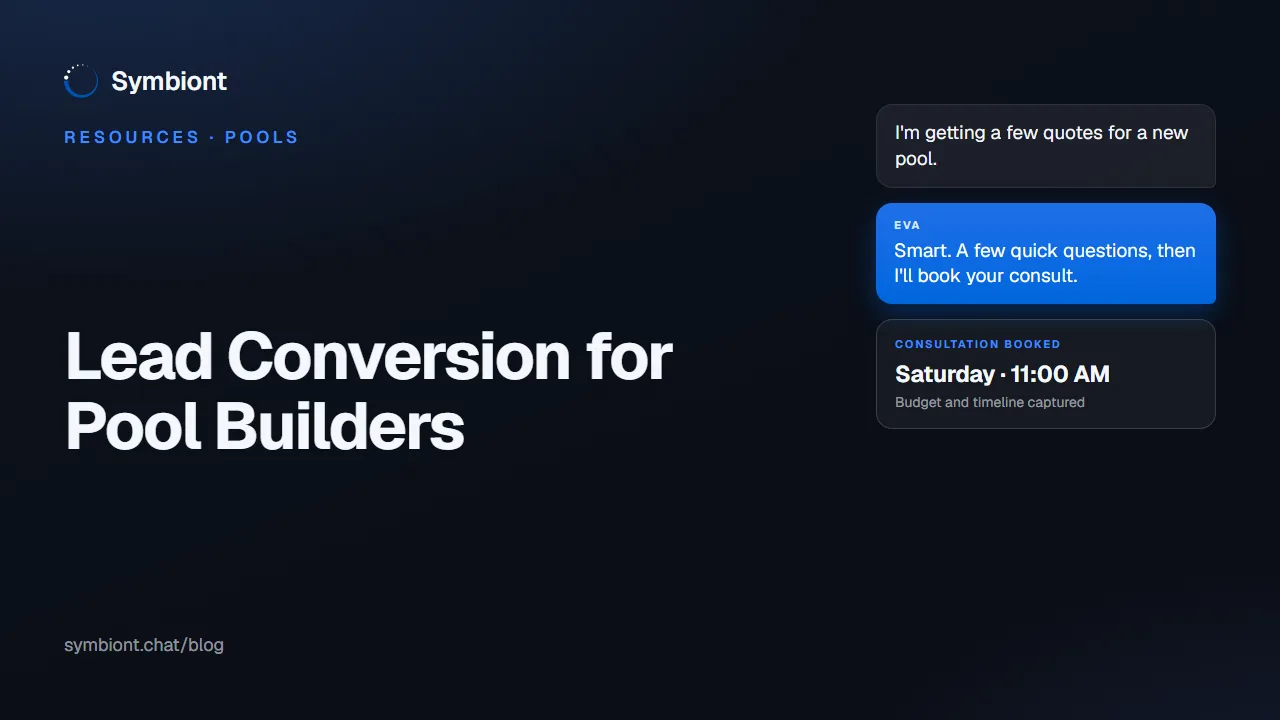
Symbiont is the company behind Eva, an AI assistant built for high-ticket, appointment-driven businesses like automotive dealerships and pool builders. Eva is a website chat that answers every inquiry in seconds, in 50+ languages, qualifies the homeowner on budget, project type, and timeline, lets them explore options and financing in the chat, and captures the consultation request with the full conversation attached for the team. Symbiont does not re-route the leads your forms already get. It converts the quiet browsers who leave without converting, roughly 98 of every 100 first-time visits by Contentsquare's benchmark, by giving them something first: their own pool, rendered in their own yard. Your existing calls to action keep working exactly as they do today.


The proof is clearest in automotive, an analogous high-ticket, considered-purchase vertical. At Coast Buick GMC, a dealership we serve, Symbiont adds about half a point to a point of website lead conversion on top of what the store's forms already produce, and 8 in 10 of those leads arrive through an interactive "Build my deal" feature that engages the buyer while they are still configuring their purchase. Pool builders run the identical flow as "Design my pool," a website funnel that captures the lead in the moment a homeowner is designing their pool instead of waiting for a form. The buying behavior is the same in both verticals: a large purchase, a long decision, and a customer who commits with whoever engages them first and answers best.
More leads or better conversion. Where should the budget go?
For most pool builders, the budget is better spent on conversion than on more leads. A lead generation company sells more inquiries. Conversion decides how many of those inquiries become booked jobs, and most builders are over-invested in the first and starving the second. If inquiries already arrive but the booked-appointment rate is low, buying more is pouring water into a leaky bucket. Plug the leak first.
| Lever | What most builders do | What actually wins |
|---|---|---|
| Lead volume | Spend more on ads | Already spending, diminishing returns |
| Response time | Reply in hours or days | Answered in the chat in seconds |
| After-hours inquiries | Sit in an inbox till morning | Answered and captured automatically |
| Qualifying and booking | Done later, if anyone gets to it | Handled in the chat, up front |
Frequently asked questions
What is lead conversion for pool builders?
Lead conversion for pool builders is the process of turning an inbound inquiry, such as a new-build, remodel, or quote request, into a booked consultation and a signed contract. It depends far more on response speed and follow-up than on lead volume.
What is the cost per lead conversion for pool builders?
There is no single figure. It depends on channel, close rate, and exclusivity: vendors that publish pricing list pool leads from about $55 each for organic up to $200 for exclusive qualified ones. The more useful number is cost per booked job, since one signed pool contract often covers a large share of a builder's marketing budget.
How much do lead generation companies charge for pool leads?
It varies widely by market and lead quality, and the bigger hidden cost is usually the leads a builder buys but never converts. Before spending more to buy additional leads, a builder should make sure the inquiries they already get are being answered and booked, which is almost always the cheaper lever.
How fast should a pool builder respond to a new lead?
Within minutes: response speed is the single biggest lever on whether an inquiry books, and it deserves its own playbook. The full research, benchmarks, and how to hit them around the clock are covered in speed to lead for pool companies.
Won't an AI sound like a bot or annoy homeowners?
Done right, no. Eva is trained on the builder's business and voice to give instant, human-quality replies in the website chat, and it hands the conversation to a person the moment one is needed, so the homeowner feels answered rather than deflected.
Will an AI book junk appointments?
No. Eva qualifies the homeowner in the chat and captures the consultation request with the full conversation and the design attached, so the team arrives knowing what the homeowner built and what they asked.
How is lead conversion different from website conversion?
They are two halves of the same funnel. Website conversion turns anonymous visitors into named inquiries, before anyone reaches out. Lead conversion is what happens after: how fast you respond, how well you qualify, and how persistently you follow up until the job is signed. Few inquiries is a website-conversion problem; few booked jobs is a lead-conversion problem.
See it work on your own leads
Get a Demo or call 941-404-5402. The fastest way to see the gap is to watch Eva answer and book real inquiries in the chat on a pool builder's own site.