Pools
Why Pool Buyers Want to See the Pool in Their Own Yard Before They Commit
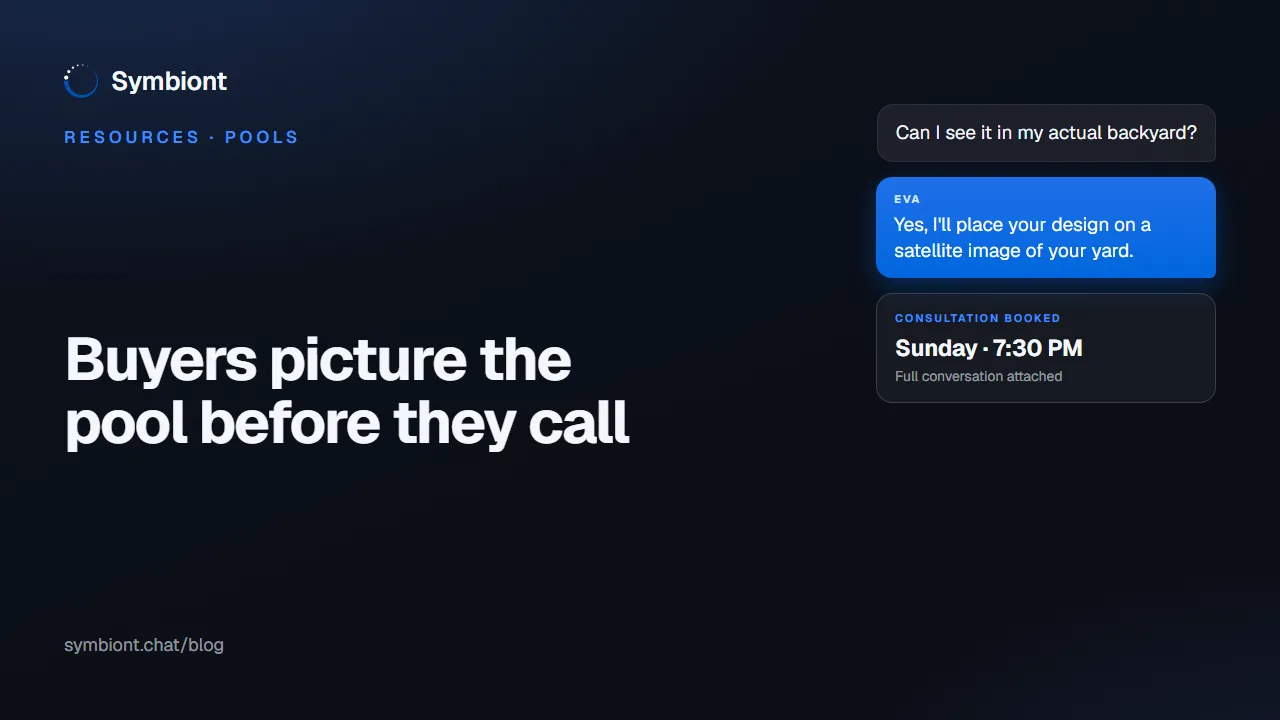
Pool buyers want to see the pool in their own yard before they buy because a $50,000 to $150,000 build is decided in the imagination long before anyone signs. They are not shopping for concrete and tile. They are picturing themselves owning a finished result, and the closer your site gets them to that picture, the more committed they arrive.
My read on this comes from cars, not pools. The buyers who hesitated longest were rarely the ones who could not afford the payment. They were the ones who never got to see themselves in the specific car, in their own driveway, before someone asked them to decide. A finished pool is the same emotional purchase scaled up. Below is what the research says, where it is contested, and what it means for how you put the pool in front of a buyer.
Why do pool buyers want to picture the finished pool before they ever contact a builder?
Pool buyers want to picture the finished pool first because a high-ticket, slow-to-deliver purchase is mostly an act of imagination. Nobody can test-soak the pool before it exists, and there is no returning it if it disappoints. Every reassuring signal a normal purchase gives is missing, so the buyer rehearses owning the pool in their head. A builder's site that helps them rehearse that ownership wins the buyer who is otherwise just collecting tabs.
What does the endowment effect say about a buyer who can already picture the pool?
The endowment effect says people value a thing more once they feel they own it, even momentarily. In the classic experiments by Kahneman, Knetsch and Thaler, randomly endowing people with a coffee mug roughly doubled what they demanded to give it up versus what others would pay to get one (Journal of Political Economy, 1990).
A mug is a few dollars. A pool is the most expensive single thing many families add to a home. The point is the mechanism, not the mug: the felt sense of ownership inflates value. A buyer who has watched a specific pool appear in their specific yard has crossed a small line from "a pool" to "my pool." That is a more committed buyer reaching out, not a colder one, no longer weighing whether to build but defending a pool they already pictured owning.
What does the IKEA effect add, and where does it stop?
The IKEA effect adds that people value things more when they help make them. Norton, Mochon and Ariely found that people who assembled their own products valued those amateur creations as highly as work made by experts (Journal of Consumer Psychology, 2012). A buyer who chooses the shape, depth, tanning ledge and lighting is doing that kind of small labor, and walking away more attached.
Here is the boundary condition that matters, stated plainly in the same study: the effect only holds when the effort reaches a completed result. When people built something and then could not finish it, or saw it destroyed, the extra attachment vanished. The lesson is unforgiving. A configurator that stalls or wastes a buyer's ten minutes does the opposite of bonding them. The design has to land on a finished picture, or it backfires.
Why does seeing the pool in their own backyard beat a beautiful showroom photo?
Seeing the pool in their own backyard beats a showroom photo because the gap the buyer has to imagine across collapses. A gallery shot is someone else's yard, grade and afternoon light, and the buyer still has to transplant it in their head. A render in their own space does that work for them.
Marketing research on placing products in a customer's real environment, rather than a generic studio, found it creates a sense of "spatial presence" that raises perceived value and decision comfort (Journal of the Academy of Marketing Science, 2017). A later field study reached the same place from real purchases: when buyers saw a product in their own at-home context, purchases rose, driven by improved self-projection, the ease of seeing yourself with the thing (Journal of Interactive Marketing, 2022). Your buyer's backyard, not a stock pool, is the context that closes the imagination gap.
How solid is this research, honestly?
It is well-supported but not settled, and a builder should hold it that way. The endowment effect in particular has been challenged: when Plott and Zeiler tightened the procedure and trained subjects on it, the gap between what sellers demanded and buyers offered disappeared (American Economic Review, 2005). The effect is also moderated, not universal. Trading experience and familiarity shrink it, and a first novelty can fade. Treat "imagined ownership roughly doubles value" as a strong directional finding, not a physical constant.
Worth flagging too: the spatial-presence and self-projection findings above were measured in augmented-reality setups, where the product appears live through a phone camera. Eva's render is a static image, not AR, so what transfers is the mechanism, seeing the thing in your own space closes the imagination gap, not the camera that delivers it.
There is a bigger honesty point. None of these studies are about pools, and none measured the exact chain a builder cares about: an on-site render to an AI chat to a booked consultation. The transfer is by analogy from furniture, home improvement and configurable goods. It is well-evidenced, but it is an analogy, and I would rather you knew that than oversold it.
What I can show you is in-house, not borrowed. At Coast Buick GMC, a dealership we serve, 8 in 10 of the website leads come through the buyer building their own deal on the site rather than filling out a contact form. Same behavior, different price tag: let a buyer construct the thing they want, and far more step forward as named leads. That is the evidence I trust most, because it is ours.
What does this mean for how a builder presents the pool on the site?
It means your site should let a buyer reach the picture of ownership before it asks for anything. A photo gallery is worth keeping for trust, but a photo cannot be owned in advance. The presentation that converts lets the buyer shape a pool, see it in their actual yard, then leave their details to get the design sent over.
Two things this post deliberately hands off. The math, what that on-site behavior does to your conversion rate, is owned by our guide to website conversion for pool builders. The mechanics, how an in-chat designer works versus a photo gallery, are covered in pool design tools for builders. This post stayed on the layer underneath both: why the buyer wants the picture at all. If your traffic is healthy but your leads are thin, the related read is why your pool website gets traffic but no leads.
How does Eva by Symbiont put the pool in the buyer's yard before asking for contact?
Eva by Symbiont, the AI assistant Symbiont built for pool companies, is designed around exactly this psychology. A visitor describes the shape, size, features and feel they want in the chat, and Eva produces one AI rendering of that pool composited into their actual backyard in under 60 seconds, from a satellite image of their address, a picture they upload, or a photo they take, and delivers it on the buyer's own landing page. The buyer sees their pool, in their yard, first. Symbiont does not re-route the leads your forms already get. It converts the quiet browsers who leave without converting, roughly 98 of every 100 first-time visits by Contentsquare's benchmark, by giving them something first: their own pool, rendered in their own yard. Your existing calls to action keep working exactly as they do today.


Only then does Eva ask for contact details so the design can be sent over. The order is the whole point. By the time the buyer becomes a named lead, they have already pictured owning a specific pool, and your team gets that vision attached to the lead instead of a blank "tell us about your project" form. The work that decides the purchase happens on your site, on your render, with your name on it.
Frequently asked questions
Why do high-ticket pool buyers behave differently from low-cost shoppers?
A pool cannot be tried, returned, or quickly replaced, and it costs more than most things a family ever buys for a home. That removes the usual safety nets, so the buyer leans harder on imagining the finished result. The builder who helps them picture ownership earns a more committed inquiry.
Is "see it before they buy" the same as a 3D walkthrough or AR camera?
No. The research is about closing the imagination gap, not about animation or live camera. Eva produces a single AI render of the designed pool placed in the buyer's real backyard, not a 3D model, walkthrough, multi-angle tour, or engineering plan. One believable picture in their own yard is what does the psychological work.
Is there a downside to a design tool that does not finish cleanly?
Yes, and it is the most overlooked risk. The attachment from designing something only holds when the effort reaches a completed result. A configurator that stalls, errors, or feels like wasted time can leave a buyer less interested than a simple photo would have. The finished render has to actually land.
Does any study prove an on-site render leads to a booked pool consultation?
No study measures that exact chain, and no honest builder should claim one does. The evidence comes from furniture and home-improvement research and transfers to pools by analogy. The in-house proof we trust most is our own: at Coast Buick GMC, 8 in 10 of leads come through buyers building their own version on the site.
See it work on your own site
Your buyers are deciding in their imagination before your phone ever rings. The question is whether that picture forms on your site, on your render, or on a competitor's. See how Eva lets a buyer design their pool, watch it appear in their own backyard, and arrive as a named lead with the vision already attached.
Get a demo or call 941-404-5402.