Pools
What Pool Buyers Research Before They Ever Contact You
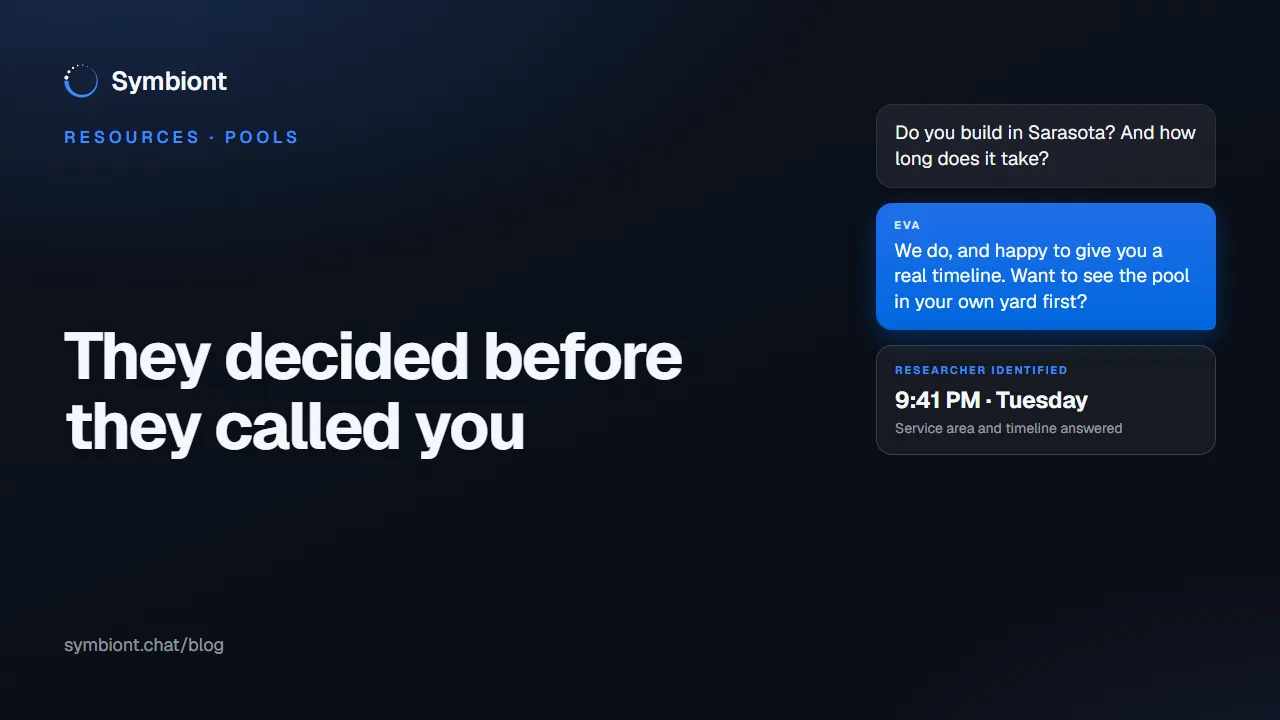
By the time a homeowner submits your contact form, they have usually been working on this for weeks. They have looked up what a pool costs, decided roughly what they want, checked whether you build in their area, read your reviews, and quietly compared you against two or three other builders. The inquiry is not the start of the sale. It is the end of a research phase you never saw.
That invisible phase is where most pool builders lose deals, because it is the only part of the process they do not staff.
When does a pool buyer's research actually start?
A pool buyer's research starts long before the inquiry, and it starts with a question rather than a builder. Somebody stands in their backyard in June, wonders whether a pool would fit, and types the question into a search bar that night. Nothing about that moment involves your company.
From there it widens. They look at pictures, work out a rough budget, argue with a spouse about whether this is the year, and only then start looking at who could build it. A builder enters the story late, and enters it as a candidate rather than a guide.
The timing is worth noting too, because it decides who gets to answer. Nearly half of high-intent inquiries arrive outside business hours. The research that precedes them skews later still, since this is a project people think about after dinner, not during a workday.
What does a pool buyer look up before they contact anyone?
Pool buyers research the same short list, roughly in this order, and almost all of it happens on other people's websites before it happens on yours.
- Cost, first and hardest. It is the question that decides whether the project is real, and it is the one most builder websites refuse to answer. They will find an average around $66,000 and a range from the mid $30,000s past $120,000 somewhere, just probably not from you.
- What kind of pool. Gunite versus fiberglass versus vinyl, size, depth, and whether a spa or a tanning ledge is affordable.
- Whether it fits. Yard size, setbacks, access for equipment, and increasingly whether the HOA will allow it.
- Whether you serve them. Service area is a surprisingly common reason a promising visitor leaves without a word.
- Whether you are any good. Reviews, photos of finished work, and how long you have been building.
- How long it takes. Timeline anxiety is real, and vague answers read as evasive.
- Whether they can finance it. Monthly cost often matters more than total cost.
Notice how much of that is factual rather than emotional. A researching buyer is assembling a decision, and every question you fail to answer is a gap they fill with someone else's website.
How solid is the data on pool buyer research, honestly?
There is no published study of how pool buyers specifically research a build. I looked, and what circulates is either vendor marketing or generic home-improvement content restated with the word "pool" swapped in. So take any confident pool-specific journey statistic with real suspicion, including from us.
What does exist is credible adjacent evidence. Houzz's 2026 U.S. Houzz Renovation Plans report, surveying 1,034 U.S. homeowners in October 2025, found 91% moving ahead with planned renovations and 93% planning to work with professionals, while 63% named rising material costs as their top concern and 25% named difficulty finding available professionals. That is renovation broadly, not pools, and it is a survey of Houzz users rather than a random sample.
Read carefully, it still tells you two useful things: cost anxiety dominates the homeowner's frame, and finding a professional who is actually available and responsive is itself a friction point. Both are things your website can address directly, and neither requires a pool-specific study to act on.
What should a pool builder publish to be findable during research?
Publish the answers to the list above, plainly, on pages a search engine can read. Most builder sites are a gallery, an about page, and a contact form, which is a brochure for someone who has already decided rather than a resource for someone deciding.
The highest-value additions are usually the least glamorous: a page with honest price ranges and what moves them, an explicit service-area page naming the towns you cover, a realistic timeline from contract to swim, and a straight comparison of pool types with trade-offs rather than a pitch for whichever you prefer to build. How to handle "how much does a pool cost?" covers the pricing conversation in depth, because that is the one builders get wrong most often.
Photos still matter, but not as proof of taste. They matter as evidence that you have built something like what this specific buyer is imagining, in a yard like theirs.
What finally makes a researching buyer become an inquiry?
A researcher becomes an inquiry when they hit a question they cannot answer alone, and someone answers it immediately. That is the whole trigger. It is rarely a compelling headline or a well-designed form. It is a specific question, at a specific moment, about their specific yard.
That is also why the moment is so easy to lose. The question arrives at 9:40 on a Tuesday night. If the only available response is a form promising a callback within one business day, the buyer does the rational thing and asks the same question of the next builder, who may answer faster. The classic 2007 Lead Response Management Study (Prof. James Oldroyd, using InsideSales data across more than 15,000 leads and 100,000 call attempts) found the odds of qualifying a prospect drop roughly 21-fold when response time stretches from 5 minutes to 30. The researcher who finally raises their hand is the most valuable visitor you will get all week, and they are usually met with silence.
How does Eva by Symbiont turn a researcher into a qualified lead?
Eva by Symbiont is the AI assistant Symbiont builds for pool builders, and her job is to be present for exactly the moment described above. She answers the cost question with your ranges, confirms whether you serve their town, explains the difference between gunite and fiberglass in your words, in 50+ languages, and does it at 9:40 on a Tuesday. If they want to see it, they design the pool and watch it rendered in their own backyard in under 60 seconds. Symbiont does not re-route the leads your forms already get. It converts the quiet browsers who leave without converting, roughly 98 of every 100 first-time visits by Contentsquare's benchmark, by giving them something first: their own pool, rendered in their own yard. Your existing calls to action keep working exactly as they do today.


Then she does something a research page cannot. The homeowner designs their pool, choosing shape, size, and features, and sees it rendered in their actual backyard from a satellite image of their address or a photo they upload. To get the design, they leave their contact details, and Eva captures the consultation request inside the same conversation. A researcher who was comparing three builders anonymously becomes a named lead with a project attached.
At Coast Buick GMC, a dealership we serve, Symbiont adds about half a point to a point of website lead conversion on top of the store's forms, and 8 in 10 of those leads come through the deal-builder rather than a plain contact form. Different vertical, same lesson: the buyers were already there and already researching. What changed was that someone answered.
For the psychology of why seeing it in their own yard shifts the decision, why pool buyers want to see it before they buy goes deeper. For the after-hours problem specifically, stop losing after-hours pool website inquiries covers the capture side.
Frequently asked questions
How long do homeowners research before contacting a pool builder?
There is no reliable published figure for pools specifically, and anyone quoting one precisely is guessing. What builders consistently report is weeks rather than days, spread across evenings and weekends. Plan for a buyer who arrives already informed, already comparing, and already carrying a rough budget in their head.
What do pool buyers care about most besides price?
Whether you serve their area, how long the build takes, and whether your finished work resembles what they are imagining. Timeline anxiety in particular is underrated: a vague answer about scheduling reads as evasion, while an honest range, even a long one, tends to build trust rather than cost the sale.
How many pool builders does a homeowner contact?
Commonly three, which is the number both Angi and Better Business Bureau guidance suggest for major home projects. Assume you are one of several from the first moment. That reframes speed, because being first to give a real answer is often what removes the other two from consideration.
Should a pool builder publish project timelines?
Yes, as an honest range with the variables named: permitting, weather, and equipment lead times. Buyers researching a large project are trying to plan a summer around it. A builder who says "roughly 10 to 16 weeks from permit, depending on inspections" is more credible than one who says it depends.
Does a photo gallery still matter?
Yes, but as evidence rather than decoration. A buyer is looking for proof you have built something like what they want, in a yard shaped like theirs. Galleries organized by pool type, size, or feature do that work. An undifferentiated grid of your best photography does not.
See what your researchers do when they finally have a question
Most of your future customers are on your site right now, deciding quietly, and they will leave without ever identifying themselves. The research phase is not unreachable. It is just unstaffed.
See how Eva answers pool questions after hours, renders the pool in the buyer's own backyard, and captures the consultation request before the conversation ends. Get a Demo or call 941-404-5402.