Pools
How to Handle 'How Much Does a Pool Cost?' Without Scaring Off Leads
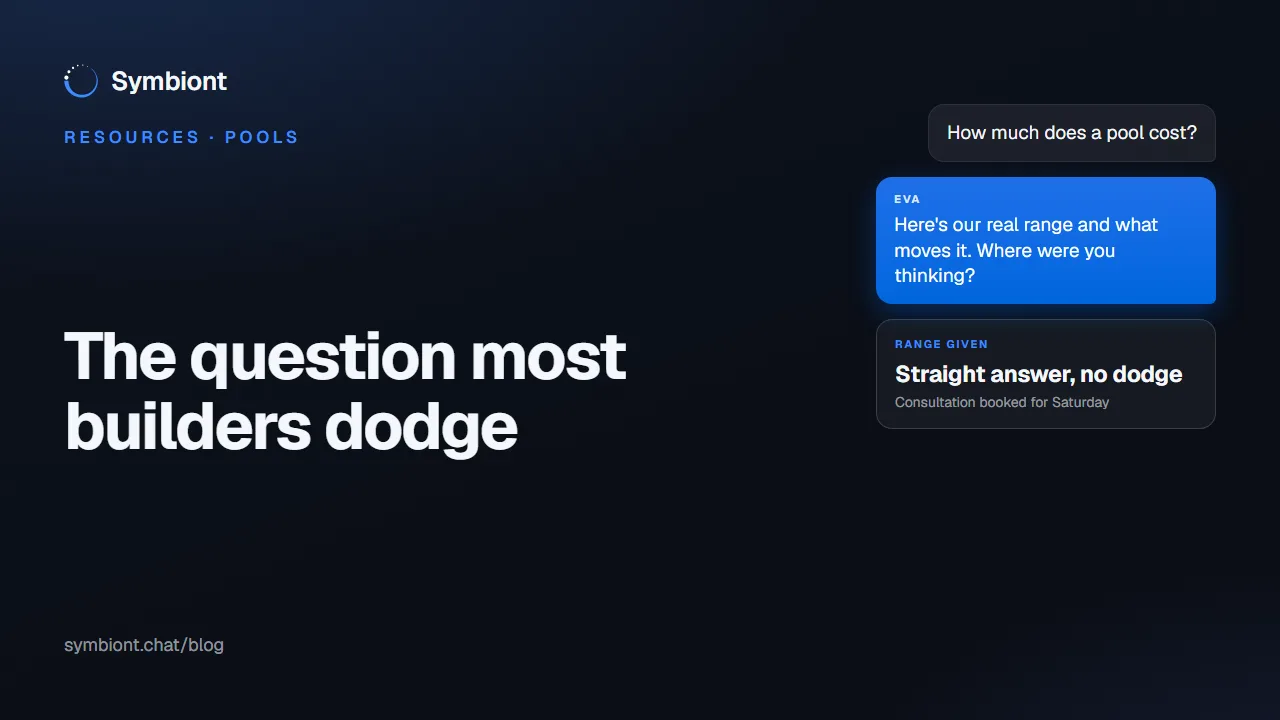
"How much does a pool cost?" is the first thing almost every homeowner asks, and it is the question the industry has trained itself to avoid. The standard answer is some version of "it depends, let's set up a consultation." That answer is technically true and commercially expensive, because the homeowner hears it as evasion and goes to ask someone else. The better answer takes thirty seconds: give an honest range, name what moves a project within it, and save the exact number for the yard.
This is written for builders, not buyers. The question is not what a pool costs. The question is what you should say when someone asks.
Why does the cost question decide whether the lead survives?
The cost question decides the lead because it is a trust test disguised as a pricing request. The homeowner already knows you cannot quote a firm number without seeing the yard. What they are actually checking is whether you will treat them straight before they have paid you anything.
Answer with a real range and you have demonstrated two things at once: that you know your own economics, and that you are not going to play games. Dodge, and the homeowner draws the obvious conclusion, which is that the number is bad enough to need hiding. Neither of those is about price. Both are about whether they keep talking to you.
There is a practical dimension too. A homeowner who cannot get a range from you cannot decide whether to proceed, so they do the only thing available: they ask three more builders. You have not protected the sale by staying quiet. You have entered yourself into a bidding process you did not need to be in, against builders who answered.
Should a pool builder give a price range or wait for the consultation?
Give the range. Wait for the consultation to give the quote. Those are different acts and conflating them is the mistake.
A range costs you nothing because it is public information. A new inground pool averages about $66,000 and commonly runs from the mid $30,000s past $120,000, depending on type, size, and region. Your buyer can find that in fifteen seconds. Refusing to say it does not keep it secret, it just makes you the builder who would not say it.
The quote is different. A quote requires the yard, the access, the soil, the slope, the utilities, the permits, and the actual design. Saying so is not a dodge, it is the reason the consultation exists, and stated plainly it makes the appointment feel necessary rather than like a sales trap.
So the shape of the good answer is: here is the honest range, here is what moves you within it, and here is what I need to see before I can put a real number on your project.
What is a defensible way to answer the cost question?
A defensible answer has four parts and takes about thirty seconds. It gives a range, explains the spread, places the buyer inside it, and names the next step.
- Lead with the range, not the caveat. "Most of what we build lands between the mid $40,000s and the high $80,000s" beats "well, there are a lot of factors."
- Explain what moves the number. Pool type, size, decking, water features, screen enclosure, and site access do most of the work. Name three or four so the range stops feeling arbitrary.
- Place them in it. "For a yard your size with a paver deck, you would be looking at the middle of that range" is worth more than the range alone.
- Separate range from quote, out loud. Say why the site visit is what turns an estimate into a number you will stand behind.
- Never invent precision. A confident wrong number costs more than a vague right one, because you will have to retract it.
The tone matters as much as the content. You are not defending a price, you are helping someone work out whether this project is real for them. Builders who sound like they are protecting information lose to builders who sound like they are helping.
How do you answer the price question and qualify at the same time?
Answering the price question is the best qualification opportunity you will get, because a homeowner who just heard a real number will tell you where they stand without being interrogated.
The move is to answer, then ask one question back. "Most projects land between the mid $40,000s and the high $80,000s. Does that fit roughly where you were thinking?" The response sorts your pipeline instantly. "That's about what I expected" is a live project. "Oh, I was thinking twenty" is a conversation about scope, or a polite exit that saves you a truck roll. Silence usually means a spouse needs consulting.
Notice this only works if you answered first. Asking a homeowner for their budget before you have given them anything is the move they have learned to resent, and it is why so many refuse to give a number. How to qualify pool leads automatically covers the four questions that actually sort a pool lead, and budget is the one that gets easier the moment you go first.
What should a builder never do with the cost question?
There are four responses that reliably lose the lead, and all four are common.
Never answer with a form. "Fill this out and we'll get back to you with pricing" trades the moment of highest intent for an email you will send tomorrow. Never quote a firm price sight unseen to win the call, because you will either eat the difference or retract it, and retracting is worse than the original silence. Never make the range so wide it says nothing: "anywhere from thirty to two hundred thousand" is a non-answer wearing a number. Never treat the question as an objection. It is the opposite. Someone asking what it costs is telling you they are considering buying.
How does Eva by Symbiont handle the cost question at 9 p.m.?
Most cost questions do not arrive during business hours. Nearly half of high-intent inquiries come in outside them, which means the single most important question in your sales process is usually asked when nobody is there to answer it.
Eva by Symbiont is the AI assistant Symbiont builds for pool builders, and this is the exact moment she is built for. She answers the cost question with your ranges, in your voice, in 50+ languages, with your rules about what you will and will not quote. Then she does the thing a price page cannot: she makes the number concrete. The homeowner designs their pool, picking shape, size, and features, and sees it rendered in their actual backyard in under 60 seconds, from a satellite image of their address or a photo they upload. To get the design on their own landing page, they leave their contact details, and Eva captures the consultation request in the same conversation. Symbiont does not re-route the leads your forms already get. It converts the quiet browsers who leave without converting, roughly 98 of every 100 first-time visits by Contentsquare's benchmark, by giving them something first: their own pool, rendered in their own yard. Your existing calls to action keep working exactly as they do today.


That changes what the price means. A number attached to a pool the homeowner designed for their own yard is a proposal. The same number in the abstract is just a figure to compare against two other builders. Why pool buyers want to see it before they buy covers the ownership psychology behind that difference, and pool consultation booking covers turning the conversation into a held appointment.
At Coast Buick GMC, a dealership we serve, 8 in 10 of the leads Symbiont produces come through the deal-builder rather than a plain contact form, and they add about half a point to a point of website lead conversion on top of what the store's forms already do. Cars are not pools, but the mechanic transfers: buyers who are allowed to build the thing and see the number stop shopping and start deciding.
Frequently asked questions
Should I put pool prices on my website?
Put ranges on your website, not fixed prices. A published range answers the question buyers actually have, filters out projects you cannot serve, and signals confidence. Fixed prices invite disputes once site conditions appear. Pair the range with what moves it, and make it easy to start a real conversation from there.
What price range should a pool builder quote before seeing the property?
Quote the range your own last twenty projects actually landed in, not a national average. Your local costs, permitting, and typical scope matter more than any published figure. State the range, name the three or four variables that move a project within it, and reserve firm numbers for after the site visit.
Does giving a range scare off buyers?
It scares off the wrong ones, which is the point. A homeowner with a $20,000 budget was never your customer, and finding that out in the first minute saves a wasted consultation. Buyers with realistic budgets read a straight range as competence, and they are the ones who book.
How do I handle a homeowner whose budget is clearly too low?
Tell them plainly and give them something useful: what their number could buy, whether a smaller or different pool type fits, or roughly what they would need to reach. Homeowners remember the builder who was honest instead of dismissive, and budgets change. Do not burn a truck roll on it.
What if a competitor quotes a lower price?
Find out what is in each number before defending yours. Pool bids often differ on scope rather than margin: decking, equipment tier, warranty, and permitting are the usual gaps. Walk the homeowner through what your number includes and what a cheaper one typically leaves out, without disparaging the other builder.
See how the cost question gets answered when nobody is at the desk
The cost question is not a threat to your sales process. It is your sales process, and most builders lose it at 9 p.m. on a Saturday to silence.
See how Eva answers pool pricing questions in your voice, renders the pool in the buyer's own backyard, and captures the consultation request before the conversation ends. Get a demo or call 941-404-5402.