Automotive
Dealership Internet Lead Response Time: What the Data Actually Says
Four independent studies have measured dealership internet lead response time over the last two years, and they agree on the shape of it: most stores now answer fast, the answers themselves are thin, and the sale is effectively decided within three days of the inquiry. This post lays out what each study actually measured and the math a slow store is quietly paying.
If you want the operating doctrine, how fast is fast enough and how to hit it, that lives in our guide to speed to lead for car dealerships. This one is the evidence file underneath it: the benchmarks, where each number comes from, and what it is safe to conclude.
Which studies actually measure dealership lead response time?
Four current sources measure it, each a different way, which is why their numbers differ and why quoting one number as "the" benchmark misleads.
- Pied Piper's Internet Lead Effectiveness study mystery-shops dealer websites: in the 2026 edition, 3,290 dealership websites received an inquiry about an in-stock vehicle, then were graded on speed and quality across email, phone, chat, and text for 24 hours.
- DAS Technology's lead response study sent about 1,700 inquiries through vehicle detail pages in the second half of 2024 and clocked the replies against a 2022 baseline.
- Foureyes benchmarks aggregate platform data at scale: 1.4 billion dealer website visits across 22,900+ dealership sites in the 2026 report.
- Urban Science's defection research matches inquiries to actual sales records to see where the buyer eventually bought.
Underneath all four sits the classic 2007 Lead Response Management Study (Prof. James Oldroyd, InsideSales data, 15,000+ leads and 100,000+ call attempts): odds of qualifying a prospect fall about 21-fold when the first response stretches from five minutes to thirty, and odds of reaching them at all fall roughly a hundredfold. It is not automotive-specific, and nothing since has moved its bar slower.
How fast do dealerships respond to internet leads in 2026?
Faster than their reputation, at least on the first touch. In the DAS study, 61% of dealerships responded to a VDP inquiry within 15 minutes, up from 55% in 2022; 19% still took over an hour. Pied Piper's 2026 study found dealers answered a typical website inquiry within 24 hours 78% of the time, often through automated AI messages, and 51% of dealers industrywide delivered what it grades a perfect response, twice the rate of five years ago.
Flip those numbers over and the leak appears: 22% of typical website inquiries got no answer inside a full day, and when the customer asked a more complex question, the answer rate dropped to 51%. Ask something a template cannot handle and it is roughly a coin flip whether anyone answers you at all.
What do the response numbers hide about answer quality?
Speed statistics count replies, not answers, and the content data is where dealerships fall down. In the DAS study, 74% of responses did not offer a price quote, 91% excluded payment details, and 89% failed to suggest alternative vehicles. The average store, in other words, replies quickly with an email that answers none of the three things the shopper actually asked.
That distinction is why a store can hit its 15-minute CRM target and still lose the deal. The shopper who asked about payments on a specific truck got a "thanks for your interest!" inside ten minutes and a real answer never. On the clock, that lead was handled. In the shopper's browser, the store next door answered the payment question first.
How wide is the window between the inquiry and a lost sale?
About three days. Foureyes' close-rate curve, built from more than 8 million sales opportunities in the first half of 2025, found leads close at 12.4% within the first three days, collapsing to 2.3% across days four through seven. Its 2026 benchmarks put 61.2% of eventual closes within three days of the initial website inquiry. There is no long courtship in this data; there is a short window and then a cliff.
And the buyer who slips through the window does not vanish, they defect. Urban Science's 2025 research with The Harris Poll found only about one in three leads purchase from the dealership that received the original inquiry; the rest buy elsewhere. The demand was real. The car got sold. Your store just was not the one that sold it.
What does a slow first response cost a store each month?
Run the shape of it with published numbers rather than a vendor's fantasy multiplier. Foureyes measured that the average new vehicle takes 3.3 leads to sell, with a median of two, from more than 985,000 sales in the first half of 2026. So every 100 internet leads represent roughly 30 sold units, somewhere. Urban Science's match data says only about a third of those buyers bought from the store they first asked, which leaves something like 20 units of demand per 100 leads walking out the door, month after month.
Honesty requires saying what the data does not show: no un-gated automotive study ties response minutes directly to close rate. What the primaries triangulate is damning enough. Response speed decides who gets the conversation (Oldroyd), the conversation's quality decides who gets the appointment (DAS, Pied Piper), and the whole contest ends within three days (Foureyes). A store slow or thin at step one is out before the steps it is actually good at.
How does an instant first answer change the numbers?
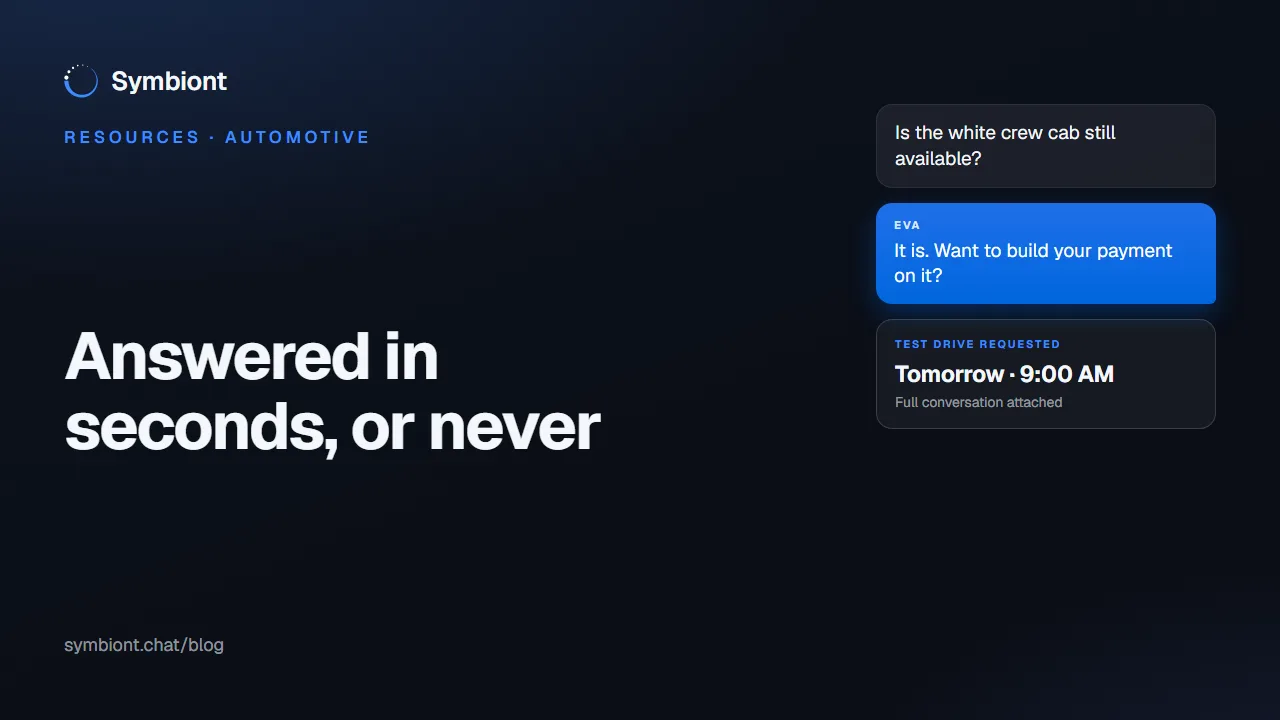
It moves the contest to the only moment you fully control: while the shopper is still on your site. Eva by Symbiont answers dealership website shoppers in seconds at any hour, in 50+ languages, and answers with substance: real inventory, trade and financing questions handled, searches guided with live match counts, payment and term configured through Build my deal, comparisons emailed, and the test-drive request, with the shopper's chosen day and time, captured for your team with the full conversation attached.


At Coast Buick GMC, a dealership we serve, Symbiont adds about half a point to a point of website lead conversion on top of the store's forms, with 8 in 10 of those leads arriving through Build my deal; the case study shows the measurement. The same response-time physics apply to any high-ticket, heavily shopped purchase, which is why we keep the parallel evidence file for pool lead response time.
Frequently asked questions
How is dealership internet lead response time measured?
Two ways, and they answer different questions. Mystery-shop studies like Pied Piper's and DAS's submit real inquiries to dealer websites and time the replies, measuring what a shopper experiences. Platform studies like Foureyes' aggregate CRM and website data at scale, measuring what happens to leads internally. Quote a benchmark only with its method attached.
What share of dealership internet leads never get an answer?
In Pied Piper's 2026 mystery-shop of 3,290 dealership websites, 22% of typical in-stock vehicle inquiries received no answer within 24 hours, and complex questions went unanswered 49% of the time. Fast average response times coexist with a stubborn share of inquiries that simply fall on the floor.
Do automated replies count as answering an internet lead?
The studies count them only when they actually answer. Pied Piper credits automation that resolves the question and flags the failure mode: when an AI first reply needed a human to follow through, customers were twice as likely to end up with no personal response at all. An acknowledgment that answers nothing is measured as what it is.
How many internet leads does it take to sell a car?
Foureyes' 2026 measurement across more than 985,000 new-vehicle sales puts it at 3.3 leads per sale on average, with a median of two. That number is a useful denominator: it converts your monthly lead count into the units of real demand flowing through your store, before response speed and quality decide how much of it you keep.
How many dealership leads end up buying from a different store?
About two in three. Urban Science's 2025 study with The Harris Poll found only around one in three leads purchase from the dealership that received their original inquiry. Defection, not dead demand, is the expensive outcome: most of those shoppers bought a vehicle, just not from the store they first contacted.
Put your own store on this curve
Every benchmark here has a store-level version you can measure this week: your median first-response time, what your first reply actually contains, and how many of last month's leads bought somewhere. The industry data says the contest is won in the first minutes and over in three days.
See how Eva answers your leads in seconds with a deal attached. Get a Demo.