Pools
Pool Lead Response Time: How Fast Should Builders Respond to New Inquiries?
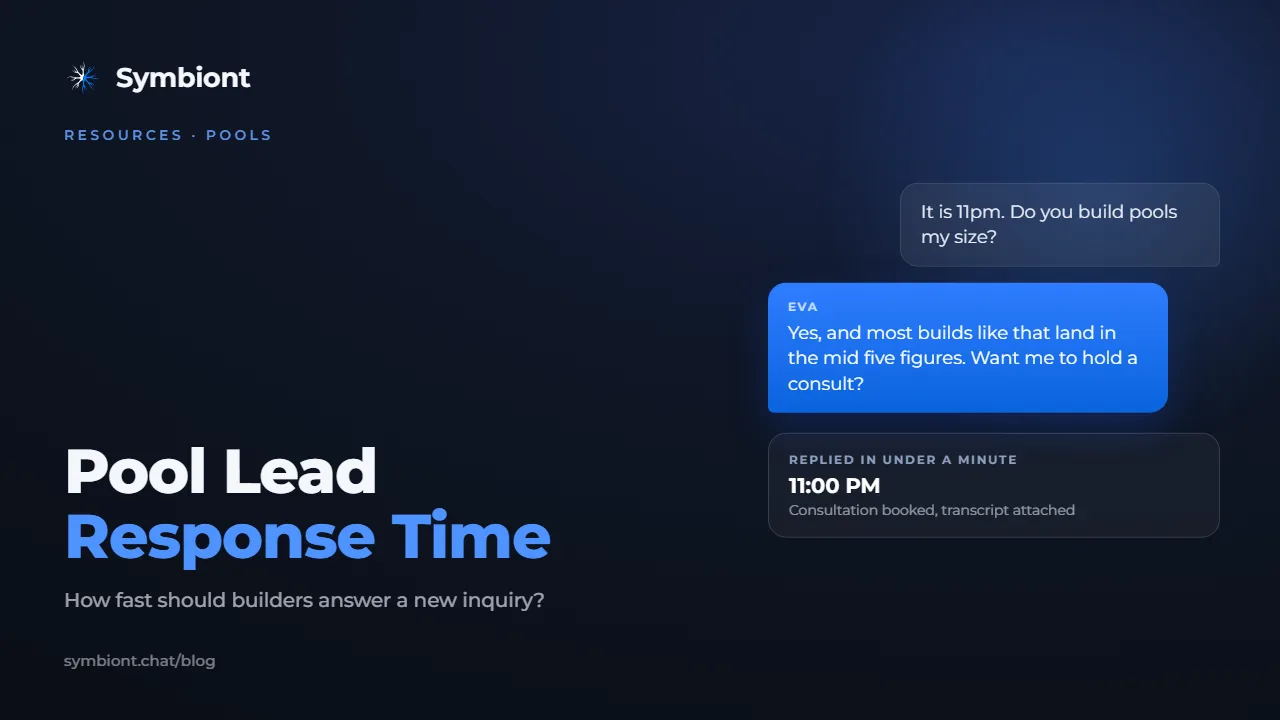
Pool lead response time is the gap between a new inquiry landing on your site and a real answer reaching the buyer. It should be under five minutes at the outside, and under a minute to win. That is the ceiling, not the goal, and it is faster than most human teams can hit on their own.
On a high-ticket, heavily shopped purchase like a pool, that gap is where the contest is decided, usually before price or portfolio ever come up. So the honest answer to "how fast should I respond" is faster than feels natural, and almost certainly faster than your office can manage between job sites.
What does the research actually say about response time?
The foundational study is old enough to drive, and it refuses to die. The Lead Response Management Study, run by Prof. James Oldroyd on InsideSales data covering more than 15,000 leads and 100,000 call attempts, tracked what happened when companies answered web leads at different speeds. Stretching the response from five minutes to thirty produced a 21-fold drop in the odds of qualifying the prospect, and the odds of even reaching the person fell roughly a hundredfold. Treat it as the classic, because the data is from 2007. Then notice that every replication since has tightened the screw rather than loosened it: as buyers moved to phones and started submitting several forms in one sitting, the window got shorter, not longer. No serious re-test has ever moved the bar slower.
The takeaway is not a magic number. It is a direction. Faster is always better, the curve is steepest in the first few minutes, and "we call everyone back within a day" stopped being competitive a long time ago.
How fast do pool builders actually respond?
This is where the opportunity hides, because the bar is on the floor. In a 2020 study of 114 companies, Workato found that more than 99 percent failed to respond to a web lead within five minutes, with the average personalized reply taking nearly twelve hours. That is the standard your competitors are setting, and it is low.
Read that as a race you can win this quarter. If almost nobody answers inside five minutes, simply beating the clock makes you the first responder in most contests you enter, and on a considered purchase the first real answer usually frames every conversation that comes after it.
The reason the average is so slow is not laziness. Picture your own Tuesday. You are ankle-deep at a dig at 2pm, phone in the truck, crew asking about the skimmer line. The office is one person who is also handling permits, billing, and a warranty call. Nobody is staffing the website. That is not a discipline failure. It is the physics of running a build operation, and it is exactly why response times stretch into hours.
Why do pool inquiries go cold so fast?
A pool is a considered purchase, which means your inquiry almost never arrives alone. Most homeowners gather at least three quotes before hiring a contractor, and most do it the efficient way: same evening, same couch, three tabs, three forms. The moment your notification chimes, two competitors got the same chime. The buyer is not waiting politely for all three of you to reply in your own time. She is talking to whoever answers, and that first conversation frames the rest.
Then there is the clock itself. Across home services, nearly half of high-intent inquiries arrive outside business hours, the hours a homeowner finally has time to think about the backyard. Your office is dark for a large share of the demand. The structural trap of pool building, where the same people who sell are the people on the job site, is the deeper reason these leads slip, and it is the territory of lead conversion for pool builders.
What does a slow response time cost on a $66,000 build?
Run your own numbers, but here is the shape of it. The average in-ground pool runs around $66,000. Say your site produces 20 inquiries a month and you respond at a leisurely pace while one competitor in your market answers inside a minute. The response research says that competitor is banking contested deals on speed alone, before price or portfolio ever enter the conversation. Swing even one job a month back your way and that is roughly $66,000 in monthly revenue recovered, against a marketing budget that probably costs a fraction of one build.
Speed is the cheapest lead source you will ever buy, because the leads are already yours. You are just losing them slowly. And buyers are not patient about it: in HubSpot's research, 82 percent of consumers rate an immediate response to a sales or marketing inquiry as important, and HubSpot defines immediate as ten minutes or less. On a $66,000 purchase, buyers read speed as competence. This is the same leak seen from the traffic side in why your pool website gets traffic but no leads; response time is the half that kills the leads you did manage to capture.
What actually counts as a response?
Not an autoresponder. "We have received your inquiry and will be in touch shortly" answers nothing, and the buyer's clock keeps running while she reads it. The research is measuring time to a real answer: do you build in her county, what does a project like hers roughly run, how long from contract to water. The clock stops when her question gets answered, not when your software acknowledges its existence.
A response that also qualifies is worth double. If the first exchange captures project type, budget range, location, and timeline, then your salesperson walks into the follow-up warm, with context, instead of cold-calling a name on a form.
How do you answer in seconds without hiring night staff?
You stop making a human the first responder and make a human the closer instead.
This is the job Eva by Symbiont, the AI assistant built for pool companies, was made for. The moment a buyer starts asking on your site, at 2pm or 11pm, Eva answers in your company's voice, in 50+ languages, in seconds with real answers about service area, realistic ranges, timelines, and financing. While the conversation runs, Eva qualifies the buyer and captures project type, budget, location, and timing, then captures the consultation request with the full transcript attached for your team, and your team can step into any conversation live. It is the same always-on mechanism that, at Coast Buick GMC, a dealership we serve, adds about half a point to a point of website lead conversion on top of the store's forms, with 8 in 10 of those leads arriving through Build my deal; since that client sells cars rather than pools, take it as proof of the mechanism, not a pool benchmark. Speed transfers across anything expensive. The full picture of the speed advantage, with the route to implementing it, lives in speed to lead for pool companies. Symbiont does not re-route the leads your forms already get. It converts the quiet browsers who leave without converting, roughly 98 of every 100 first-time visits by Contentsquare's benchmark, by giving them something first: their own pool, rendered in their own yard. Your existing calls to action keep working exactly as they do today.


Frequently asked questions
What is a good lead response time for a pool company?
Under five minutes at the absolute outside, and under a minute if you want to win consistently. The odds of qualifying a lead are far higher inside five minutes than at thirty, and because pool buyers submit to several builders at once and engage with whoever answers first, the practical target on a high-ticket build is an instant reply.
Does the five-minute rule still hold in 2026?
Yes, and it has only gotten stricter. The foundational Lead Response Management Study dates to 2007, but every replication since has confirmed it, and as buyers moved to phones the ideal window shrank rather than grew. No serious re-test has moved the bar slower, so treat under five minutes as a ceiling, not a stretch goal.
Does an auto-reply count as a response?
No. An acknowledgment email answers none of the buyer's real questions, so her clock keeps running and she keeps talking to your competitors. The research measures time to a useful answer about service area, budget, or timeline, not the moment your software confirms it received the form.
What does a slow response time actually cost a pool builder?
More than the price of the lead. On an average build around $66,000, recovering even one contested job a month from faster replies covers most builders' entire marketing budget several times over. The leads are already yours and already paid for, so slow response is not a soft metric. It is forfeited jobs.
Can AI respond fast enough to win pool leads without night staff?
Yes, and that is the point. An AI assistant answers every inquiry in seconds, day or night, qualifies the project, and captures the consultation request while your crew is on a job site or asleep. Your team stops being the first responder and becomes the closer who picks up a warm, qualified lead.
Find out how fast you really are
Send an inquiry through your own website tonight at 9pm and time what happens. If the honest answer is "tomorrow," that is the gap your competitors are living in. Then watch Eva take the same inquiry, answer it, qualify it, and book it in under a minute.
Get a demo and put a real number on your response time.