Comparisons
How to Audit a Dealer Chat Vendor's Numbers Before You Sign
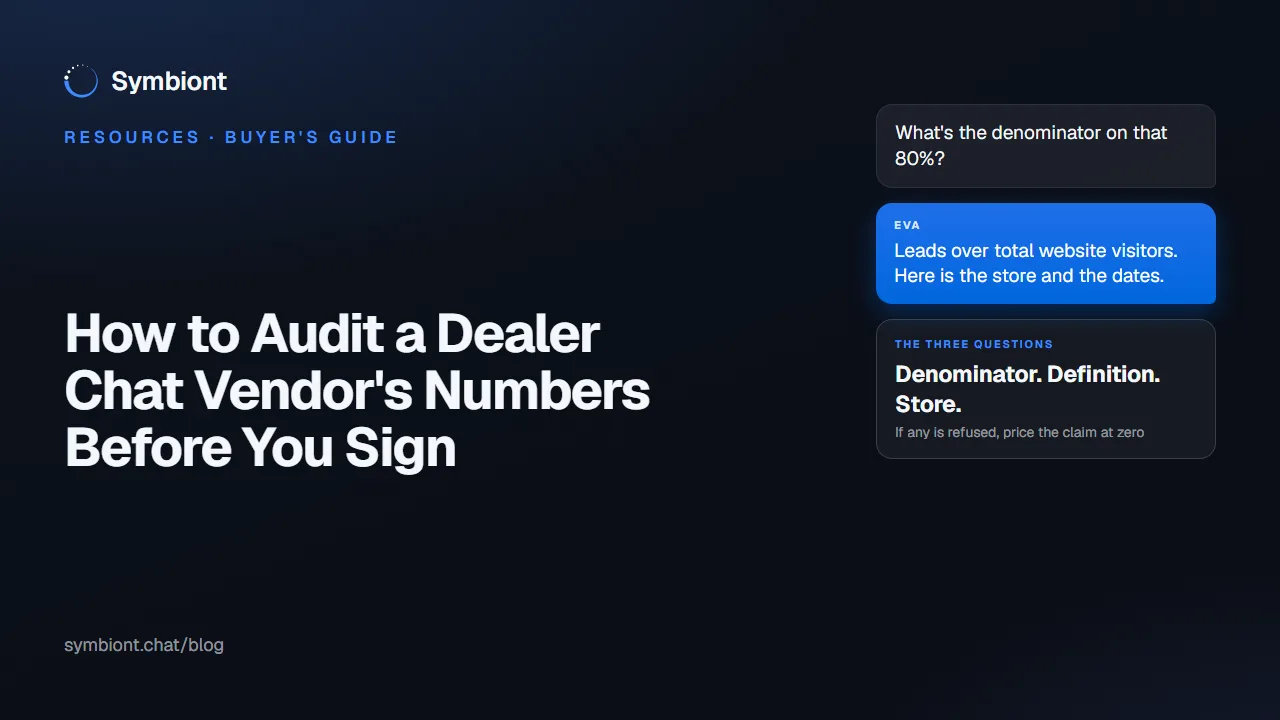
To audit a dealer chat vendor's number, ask three questions: what is the denominator, what counted as a lead, and which store did it come from. Most published chat statistics survive none of them, not because the vendors are lying, but because the numbers measure engagement, or a cherry-picked store, or a chat that could not start without a phone number. Here is how to read them.
I sat on the buying side of these pitches for nine years before co-founding Symbiont. Every vendor deck had a big number on slide two. Almost none of them would have survived a desk manager with a calculator. This is the calculator.
Why do chat vendor numbers sound so good?
Because the easiest numbers to grow are the ones that are not the business. Opens, engagements, conversations, and "interactions" all go up when a widget pops for every visitor, and none of them are a shopper your team can call. The numbers that matter, leads against your total traffic and appointments your CRM can see, are harder to move and easier to check. So the deck leads with the first kind.
The published claims below are real, linked to where each vendor says them, and quoted as written. The point is not that they are false. The point is that none of them can be evaluated without the three questions.
Question 1: What is the denominator?
A rate is a fraction. The number on the slide is the top. The bottom decides whether it means anything.
Gubagoo's Chat Smart page states it "delivers, on average, an 80% chat-to-lead conversion rate" (Gubagoo). That is 80% of chats, not 80% of visitors. And the question to ask is what a shopper has to do before a chat begins. If the chat requires a name and a phone number before it answers a single question, then every chat is a lead by definition, and 80% is a floor, not an achievement. If it does not, 80% is remarkable and you should ask to see it in a store's dashboard.
Impel reports "more than 150% lift in engagement rates" from early deployments of its Sales AI (Impel, via GlobeNewswire). Engagement is not a lead. A 150% lift in engagement with no change in leads is a 150% lift in the noise your BDC has to sort.
The denominator that cannot be gamed is your total website traffic: leads produced, divided by the real people who visited. It is the smallest number any vendor will show you, which is exactly why it is the one to ask for. On that basis, Ruler Analytics' benchmark data puts the automotive average around 2%, so a tool that adds half a point on top of your forms is adding a quarter of what your whole site does today.
Question 2: What counted as a lead?
An early Gubagoo press release, still widely circulated, describes early-adopter dealerships "driving over 200 incremental leads directly from Gubagoo each month" at a 15% close rate (Gubagoo, via PRWeb). Two hundred of what? A shopper who asked for service hours and typed a phone number to get them counts as a lead in most chat reporting. So does someone who asked whether you are open on Sunday.
The sanity test is the one your desk already runs: how many of those leads arrived with a vehicle, a payment structure, and a reason to call? A lead that shows up with a deal the shopper built themselves is a different unit of work from a name and a number, even when the report counts them the same. Ask the vendor what share of its "leads" carry a vehicle and a deal structure. If the answer is a pause, you have your answer.
Question 3: Where does the number live?
Impel's site states that dealerships running its Sales AI "see a 25% higher appointment-set rate and a 26% higher closing rate compared to traditional handling," and its 2026 announcement cites "up to 300% increase in appointments set autonomously by AI" and "a 44% lift in lead-to-appointment conversion" from one dealer group (Impel, GlobeNewswire). Three questions apply to every one of these. "Up to" is a ceiling from the best store in the sample; what was the median? "Compared to traditional handling" at which stores, over which months? And can you log into the dashboard that produced it, or does the number exist only in the vendor's own portal?
The attribution test is simple. A number you can check has a named store, a date range, and a system you can look at. A number you cannot check has "a dealer group," "early deployments," and a press release. Vendors are not obliged to name customers, but you are entitled to ask for one reference store whose dashboard you can see with your own eyes.
What does honest reporting look like?
Five things, and you should expect all five from anyone asking for a twelve-month contract:
- A traffic denominator. Leads against total unique visitors, not against chats or engagements.
- A definition of a lead you would accept at your own desk: contact details plus a vehicle or a deal, not a service-hours question.
- A named store and a date range. One is enough. "A dealer group" is not a store.
- A dashboard you can log into, before and after you sign, showing the same numbers the vendor quotes.
- The lower number whenever two sources disagree, stated as policy.
How does Symbiont report its numbers?
By the same five rules, because we would not pass our own test otherwise. Symbiont's automotive tools add about half a point to a point of website lead conversion on top of what a store's forms already produce, measured against total site traffic. At Coast Buick GMC, a dealership we serve, 8 in 10 of those leads arrive with a deal the shopper built in Build My Deal, and the average buyer spends over five and a half minutes building it. Those figures come from the dashboard the store logs into, the same one we run the business on. We do not have the store's CRM data, and we do not claim to. Where a figure could be read two ways, we use the lower reading.
Chat on its own does not do this. Shoppers will not talk to an AI for long, and a chat window is not a reason to leave a phone number. A deal they built and want priced is. That is the whole difference between an engagement number and a lead number, and it is why the search, comparison, and deal-building tools carry the conversion for dealerships that run Symbiont rather than the chat.


We wrote up the store in detail in the Coast Buick GMC case study, and the wider landscape, vendor by vendor, in our map of dealership live chat software. Pool builders face the identical pitch with different logos; the contact forms versus AI chat comparison covers it from that side.
FAQ: auditing dealer chat vendor claims
Is an 80% chat-to-lead conversion rate real?
It can be true and still mean little. If the chat requires a name and phone number before it answers, every chat is a lead by definition and 80% is a floor. Ask what share of website visitors became leads instead; that number cannot be gamed by a gate.
What is a good website lead conversion rate for a car dealership?
Ruler Analytics' benchmark puts the automotive average around 2% of visitors, counting every form and call on the site. A tool that adds half a point to a point on top of that, measured against the same traffic, is a meaningful lift. A tool quoting a rate against chats is answering a different question.
Should I trust numbers that say "up to"?
Treat "up to" as the best store in the sample, not the typical one. Ask for the median, the number of stores it came from, and the date range. A vendor confident in its results will give you a named reference store whose dashboard you can look at before you sign.
How do I verify a chat vendor's numbers before signing?
Ask for one reference store, its date range, and login access to the dashboard that produced the figures, then compare the vendor's lead count with what that store's CRM received. Insist on a traffic denominator and a lead definition your desk would accept. If any of the three is refused, price the claim at zero.
See the numbers on your own traffic
The only vendor number that matters is the one measured on your website, against your visitors, in a dashboard you can open. That is what a demo should show you. Get a Demo.