Pools
Pool Consultation Booking: How to Turn Inquiries Into Appointments
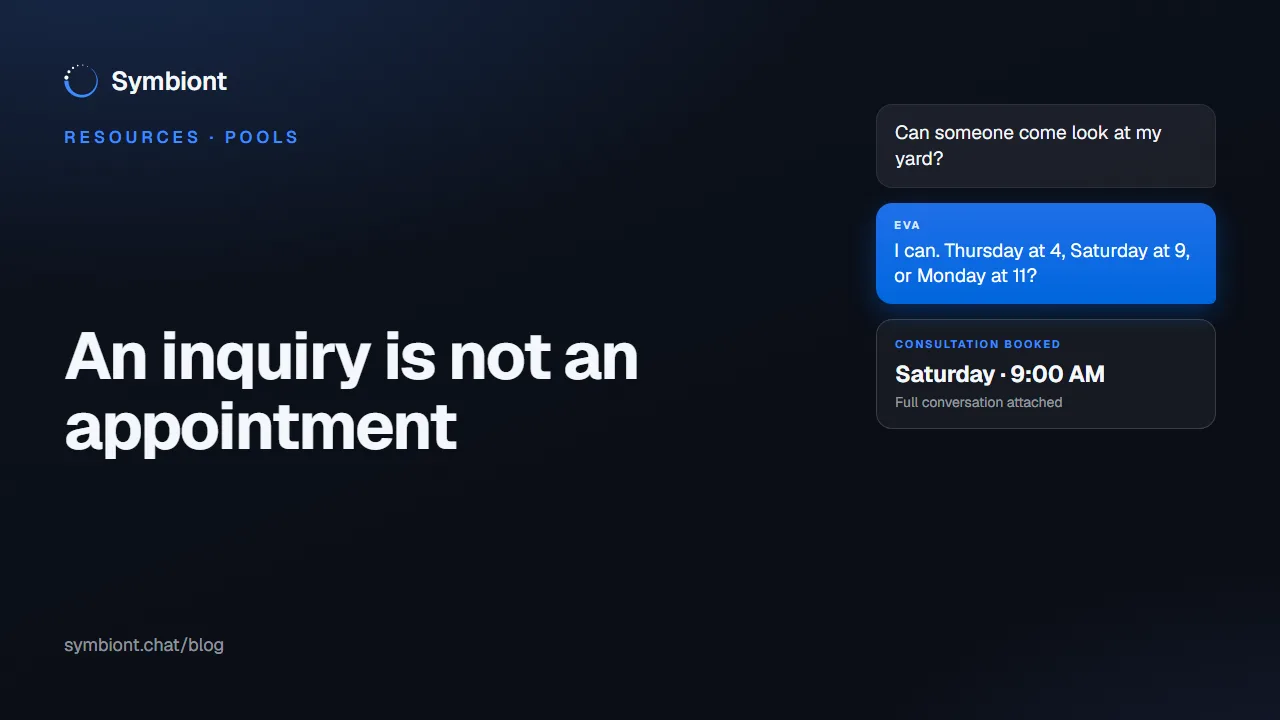
A pool consultation booking is the moment an interested homeowner stops being a name in your inbox and becomes a specific time on a specific day in your calendar. Most builders track the first half of that sentence and assume the second half follows. It does not. The gap between an inquiry and a held appointment is where the majority of pool revenue quietly disappears.
This is not about responding faster, which is a different problem with its own math. It is about the mechanics of the booking itself: what you offer, when you offer it, and what has to be true for the homeowner to show up.
What is a pool consultation booking, and when does an inquiry become one?
A pool consultation booking is a scheduled, confirmed appointment with a named time, at the property or on a call, where the builder and homeowner discuss a specific project. An inquiry is not that. A phone number is not that. "I'll have someone reach out this week" is emphatically not that.
The distinction matters because these two things have completely different survival rates. An inquiry decays: the homeowner is still shopping, still filling out other builders' forms, still moving. A booked consultation with a specific time is a commitment, and commitments hold attention in a way an open loop cannot. Every step you leave between "interested" and "on the calendar" is a step where they can leave. So the useful thing to count is not how many inquiries you got last month, but how many became a time on the calendar, and how many of those were kept.
Why do pool inquiries stall between interested and on the calendar?
Pool inquiries stall because the standard process inserts a callback between the homeowner's interest and the appointment, and the callback is where the momentum dies. The homeowner submits a form at 9 p.m., a salesperson calls at 11 a.m. the next day, the homeowner is at work, a voicemail gets left, and a thread that started with real intent becomes a game of phone tag neither side wins.
The classic 2007 Lead Response Management Study (Prof. James Oldroyd, using InsideSales data across more than 15,000 leads and 100,000 call attempts) found the odds of qualifying a prospect drop roughly 21-fold when response time stretches from 5 minutes to 30. It describes human attention rather than technology, which is why it has never stopped being true. Nearly half of high-intent inquiries arrive outside business hours, exactly when nobody is available to make that callback.
There is a second, quieter reason. A callback asks the homeowner for a conversation they have not agreed to yet, on your schedule. Offering a time asks for a decision they are already prepared to make. Builders routinely choose the harder request by default.
Pool lead response time covers the speed benchmarks and the cost of slowness. This article assumes you answered, and asks what you do with the next sixty seconds.
Does offering a specific time beat asking for a callback?
Offering a specific time beats asking for a callback for a structural reason rather than a psychological trick: a named time can be accepted or declined, while a callback can only be waited for. Acceptance and decline are both progress. Waiting is not.
In practice, the offer that converts looks like this:
- Two or three concrete options, not an open calendar. "Thursday at 4, Saturday at 9, or Monday at 11" is a decision. "When works for you?" is homework.
- The next 72 hours, weighted toward the weekend. Pool decisions get made with a spouse, and the spouse is home on Saturday.
- A stated duration and purpose. "About 45 minutes, at the property, to measure and price the design you just built" tells them what they are agreeing to.
- Confirmation in the same session, and everything they already told you attached, so the salesperson arrives knowing the yard, the budget range, and the shape they picked.
That last point is the one builders undervalue. A consultation where the builder already knows the project is a different meeting from one that starts at zero, and the homeowner feels the difference in the first minute.
What makes a booked pool consultation actually get held?
A booked pool consultation gets held when the homeowner has invested something in it, knows exactly what will happen, and gets reminded before it arrives. Remove any of those three and the appointment becomes optional in their mind, whatever your calendar says.
Investment is the one builders can most easily create and most often skip. A homeowner who picked a shape, a size, and a set of features, and saw that pool rendered in their own backyard, is not casually browsing anymore. They built something and they want it priced. That is a materially different person from someone who typed a phone number into a form. Why pool buyers want to see it before they buy covers the ownership psychology underneath it.
Clarity is second: the duration, who is coming, whether they need to be home, what they leave with. Ambiguity is what makes an appointment easy to skip.
How honest can we be about no-show rates for pool consultations?
Honestly: there is no credible published no-show rate for pool consultations, and any number you see quoted is almost certainly recycled from an unrelated industry. I went looking, and the trail for contractor consultation no-shows dead-ends in vendor blog posts citing each other. That fails our sourcing bar, so I am not going to hand you a percentage.
What does exist is real evidence that reminders work, from healthcare rather than pools. The Cochrane review Mobile phone messaging reminders for attendance at healthcare appointments (Gurol-Urganci and colleagues, 2013) found moderate-quality evidence that text reminders improved attendance versus no reminder, at a risk ratio of 1.14 with a 95% confidence interval of 1.03 to 1.26 across 7 studies and 5,841 participants. It also found texts about as effective as phone call reminders, at a risk ratio of 0.99, while costing substantially less to send.
Read that carefully. It is a modest effect measured on medical appointments, not a promise about pool consultations. What transfers is the direction and the mechanism, not the magnitude: a reminder helps, texting is a reasonable channel, and it costs almost nothing. Treat it as a floor worth having rather than a lever worth bragging about, and be suspicious of anyone selling you a bigger number.
How does Eva by Symbiont capture the consultation request inside the conversation?
Eva by Symbiont is the AI assistant Symbiont builds for pool builders, and the consultation request is the step she captures before handing off. A homeowner arrives at 9 p.m., asks what a pool costs, and instead of meeting a form, they design one: shape, size, and features, rendered into their actual backyard in under 60 seconds from a satellite image of their address or a photo they upload. To get the design on their own landing page, they leave their contact details and ask for a consultation, in the same conversation, in 50+ languages. Confirming the time stays with your team; Eva does not write to a live calendar. Symbiont does not re-route the leads your forms already get. It converts the quiet browsers who leave without converting, roughly 98 of every 100 first-time visits by Contentsquare's benchmark, by giving them something first: their own pool, rendered in their own yard. Your existing calls to action keep working exactly as they do today.


That produces a consultation request attached to a project rather than a phone number attached to a hope. The salesperson opens the record and sees the yard, the design the homeowner built, and the full conversation, which averages about five minutes. That is five minutes of qualification the team no longer performs cold.
At Coast Buick GMC, a dealership we serve, 8 in 10 of the leads Symbiont produces arrive through the deal-builder rather than a plain contact form, adding about half a point to a point of website lead conversion on top of what the store's forms already do. Different vertical, same mechanic: let the buyer build the thing they want, then capture the lead at the moment they want it priced.
Eva does not make outbound calls or run your sales process. She converts the traffic already on your site into consultation requests your team can confirm and keep. If you are still deciding whether chat belongs on your site at all, contact forms vs AI chat makes that comparison directly, and how to qualify pool leads automatically covers what gets asked before the booking happens.
Frequently asked questions
What is a good booking rate for pool consultations?
There is no trustworthy published benchmark for pool consultation booking rates, so treat any quoted figure with suspicion. Measure your own: booked consultations divided by total website inquiries, tracked monthly. Your own trend line over three months is far more useful than an industry average built on someone else's definitions.
Should a pool builder let homeowners self-schedule?
Yes, with guardrails. Self-scheduling removes the callback delay that kills momentum, which is its main advantage. Constrain it by offering a few specific slots rather than an open calendar, protect your crew's install hours, and require enough project detail up front that a salesperson never drives out to an unqualified appointment.
How far out should a pool consultation be scheduled?
Inside 72 hours where you can manage it, weighted toward evenings and Saturdays when both decision-makers are home. Intent decays quickly, and an appointment two weeks out gives a competitor who books for Thursday a clear run at the same homeowner. Sooner also means the design they just built is still fresh.
What should a builder send between the booking and the appointment?
A confirmation immediately, then a short reminder the day before. Include the time, the duration, who is coming, and whether the homeowner needs to be present. If they designed a pool on your site, attach it. The Cochrane reminder evidence is modest but real, and the cost of a text is nothing.
See what your inquiries become when booking happens in the conversation
Most pool builders do not have an inquiry problem. They have a gap between the inquiry and the calendar, staffed by a callback that arrives hours after the homeowner moved on.
See how Eva answers pool questions at 9 p.m., renders the pool in the buyer's own backyard, and captures the consultation request before the conversation ends. Get a Demo or call 941-404-5402.