Pools
Why Your Pool Website Gets Traffic But No Leads
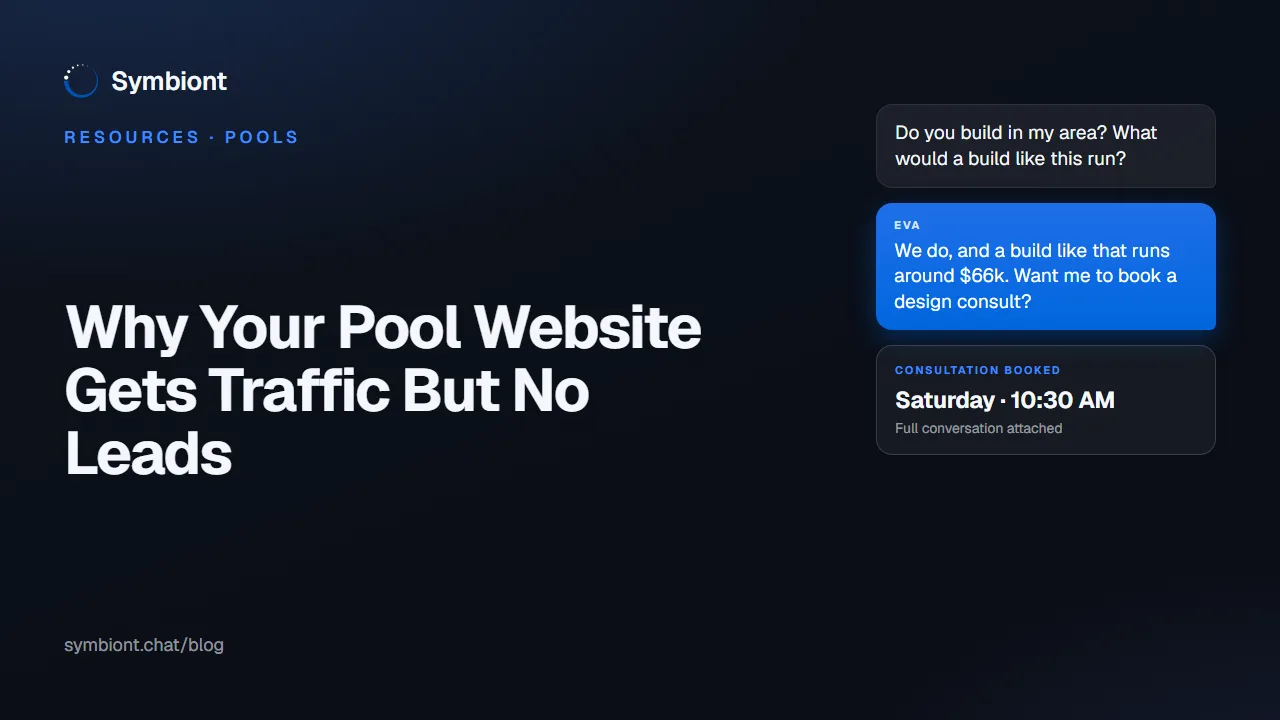
Your pool website gets traffic but no leads for one reason: it was built to show your work, not to answer a buyer the second they have a question. The visitors are real. They scroll the gallery, wonder about cost and timeline and whether you even build in their county, and then they leave, because nobody is home to answer.
That is a conversion problem, not a traffic problem. And in 2026 it is an expensive one to keep ignoring.
Start with the number that should sting. Contentsquare's Digital Experience Benchmark, built from 99 billion sessions across more than 6,000 sites, puts new-visitor conversion at 1.7 percent and returning visitors at 2.9 percent. That data skews toward ecommerce rather than contractors, so read it as the shape of the problem rather than your exact number: somewhere around 98 of every 100 first-time visitors leave without ever telling you who they are. No name, no number, no way to follow up. For a pool builder that is not a rounding error. That is most of the demand you paid to capture, walking back out the door.
Do you really have a traffic problem?
Here is what makes it sharper this year. The pandemic pool boom is over. Pool Corporation, the largest distributor in the industry, estimates in its annual report that just below 60,000 new in-ground pools were built in the U.S. in 2025, a number its CEO called about half of the pandemic peak. The wave of homeowners who would buy a pool no matter how clunky your website was has receded. What is left is a smaller, more deliberate group of buyers who shop three or four builders hard and sign with whoever makes it easiest.
So when your analytics show traffic holding steady while booked consultations stay flat, more traffic is not the answer. You can buy visitors all day. If the site converts at 2 percent, doubling traffic just means paying twice to lose the same share of people. The hole in the bucket does not care how much water you pour in. Closing that gap, between the visitor you already have and the consultation you never booked, is the whole job of website conversion for pool builders, and it is where the growth is.
Where does the lead actually slip away?
Picture the buyer. It is 9:40 on a Tuesday night, she is on the couch with her phone, the kids are finally down, and she has decided this is the year. She finds your site, looks at a few gorgeous builds, and the questions start. Do you work in her area. What does something like the pool in photo four actually run. How long from signing to swimming. Could she see it in her own yard before sitting through a sales appointment.
Your website answers none of it. It shows her a contact form.
A long form is a big ask for someone who has not decided she likes you yet. Name, email, phone, address, "tell us about your project," and then the worst three words in sales: we'll be in touch. Most people in her seat close the tab and open the next builder. The few who do fill it out become a cold lead that drops into an inbox and waits until somebody gets to it, which on a busy week might be Thursday.
Her timing is not unusual either. Across home services, nearly half of high-intent inquiries arrive outside business hours, exactly when the office is dark. Weekend leads that sit until Monday are mostly dead on arrival. By the time anyone calls back, she has already talked to the builder who answered at 9:42.
Your gallery, for all its polish, cannot rescue any of this. It builds trust, and you should keep it. But a photo does not ask her budget. It does not qualify the job. It does not put anything on your calendar. It sits there and hopes she takes the next step herself, and most people, most nights, will not.
| What the buyer is doing on your site | What your site does in response |
|---|---|
| Asking if you build in her area | Shows a service map, maybe |
| Trying to ballpark cost and timeline | Points her at a form |
| Researching at 9:40pm on a Tuesday | Promises someone will reach out |
| Imagining the pool in her own backyard | Shows a photo of someone else's |
| Ready, right now, to take a step | Asks her to fill out a form and wait |
Every line in that table is a buyer you paid for, leaving.
Can you put a real number on the leak?
Abstractions do not move anyone, so run it. Say your site pulls 1,000 first-time visitors in a month, which is modest for a builder spending anything on paid or organic. At a 1.7 percent rate, that is about 17 inquiries. Add the half a point to a point of website lead conversion we have actually measured on top of a site's existing forms (at Coast Buick GMC, a dealership we serve, so read it as proof of the mechanism, not a pool guarantee), and the same 1,000 visitors throw off 22 to 27. Call it 5 to 10 more conversations a month from traffic you already bought and paid for, every month.
Now attach a price. The average in-ground pool runs around $66,000. You will not close all of them, and on a build that size you do not have to. One extra signed job a month from leads you were already losing covers most builders' entire marketing spend several times over. That is the genuine cost of a website that displays instead of converts. It is not a soft metric on a dashboard. It is jobs.
Why do the best leads go to whoever answers first?
Speed is the other half of the leak. The landmark research here is blunt: the classic 2007 Lead Response Management Study (Prof. James Oldroyd, on InsideSales data) found that letting a response slip from five minutes to thirty cut the odds of qualifying the lead about 21-fold. The homeowner researching at night is comparing builders in real time, and the one who answers while she is still curious is usually the one who ends up in her backyard with a tape measure. Response speed is a discipline of its own, with its own playbook in pool lead response time and the full speed to lead for pool companies guide. This post stays on the step before it: catching the visitor at all.
What does converting actually look like?
Converting means catching that buyer while she is still on the page. Answer the real question. Qualify the project. Capture the consultation request before she leaves, while the interest is still warm.
That is the work Eva by Symbiont, the AI assistant built for pool companies, does on a builder's site. The second a visitor lands, Eva answers the cost, timeline, and service-area questions they walked in with, and captures what your team needs to act: project type, budget, location, timeline. When the buyer is ready, Eva captures the consultation request with the full conversation attached for your team. The part that stops pool shoppers in their tracks: they can design the pool right there and watch it rendered into their own backyard in under 60 seconds, from a satellite image or an uploaded photo, long before a contact form would have caught them. Symbiont is an AI chatbot and visual conversion system. Chat is the front door, not the whole product. It engages and captures the shoppers your website would have lost. If you are still comparing tools before you commit, our guide to the best chatbot for pool builders weighs the real options. Symbiont does not re-route the leads your forms already get. It converts the quiet browsers who leave without a word by giving them something first: their own pool, rendered in their own yard. Your existing calls to action keep working exactly as they do today.


What does that do to the numbers? In one deployment, taking a site from passive to genuinely conversational added about half a point to a point of website lead conversion on top of what the site's forms already produced, with 8 in 10 of those new leads arriving with a deal the buyer built. That client was an auto dealership, not a pool builder, so read it as proof of the mechanism, not a pool benchmark. The buyers were already there. The only thing that changed was that somebody answered them. Turning those captured inquiries into signed jobs is the next step, covered in lead conversion for pool builders.
Frequently asked questions
Why does my pool website get traffic but no leads?
Because it is built to display, not to convert. Buyers arrive with real questions about cost, timeline, and whether you serve their area, hit a gallery and a contact form instead of answers, and leave anonymous. New visitors convert at about 1.7 percent across the wider web, so the other 98 or so quietly disappear.
Will more SEO or ads fix it?
Usually not on their own. If the page converts at 2 percent, more traffic just feeds the same leak at a higher cost per visitor. Traffic and conversion are two different problems, and when the leads are missing, it is almost always the conversion side that is broken.
Isn't a contact form enough for a pool builder?
For a $66,000 purchase, rarely. A long form asks a lot of someone still making up her mind, so most skip it, and the few who submit become cold leads aging in an inbox. Answering the question in the moment and capturing the consultation request right then converts far more of the same traffic.
How much is a low-converting site actually costing me?
More than it looks. On 1,000 monthly first-time visitors, adding half a point to a point of conversion on top of a 1.7 percent baseline is 5 to 10 extra inquiries a month, 60 to 120 a year. Even one more signed pool out of that pile, at an average build around $66,000, pays back most builders' marketing budget many times over.
How fast can this go live on my site?
Most builders are up inside 48 hours. Eva trains on your own website and gets tuned to your services, your service area, and your policies by our team working alongside yours, then starts answering and booking from your existing traffic.
See it run on your own traffic
The visitors are already arriving, and already costing you. They leave because nobody answers them in the seconds that decide the job. Watch Eva answer a pool buyer, qualify the project, and capture the consultation request, first on a builder's site, then on yours.
Get a demo and see what your current traffic should already be turning into.