Automotive
Stop Losing After-Hours Car Dealership Leads
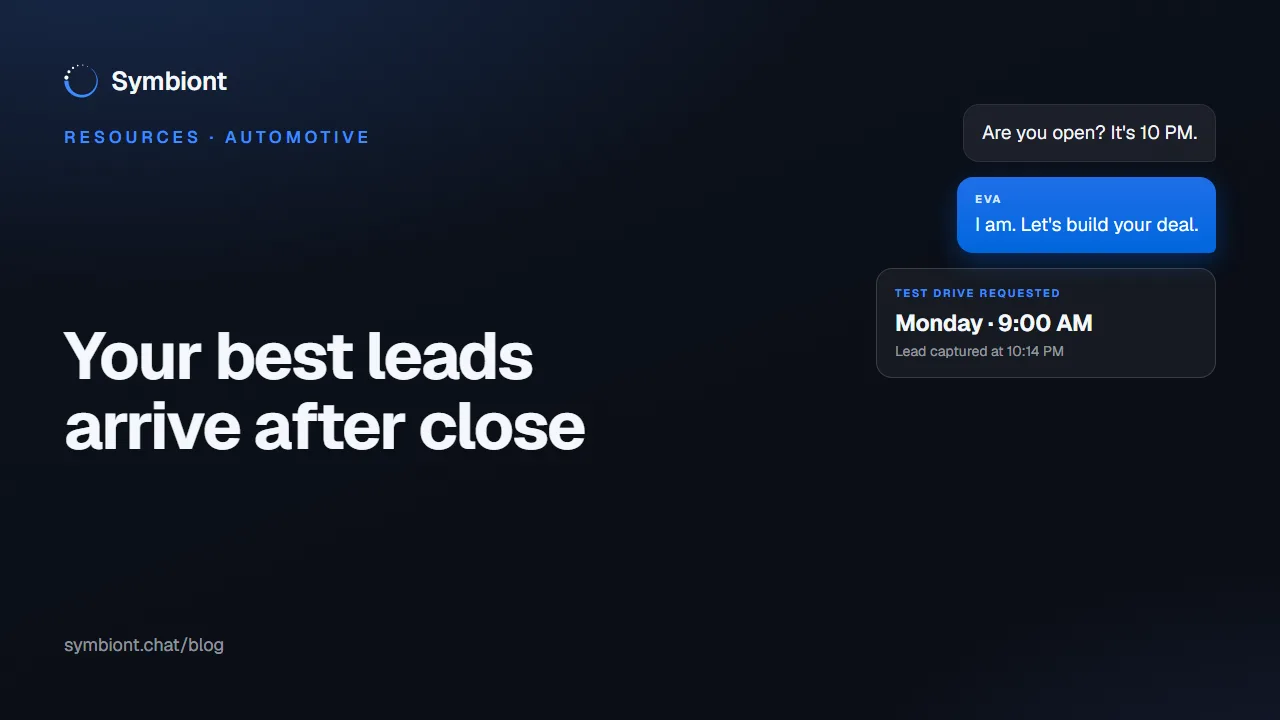
After-hours car dealership leads are the majority of your lead flow, not the exception. In a 30-day sample of 7,041 customer-initiated leads across 50 dealerships, 53% arrived outside weekday 9-to-6, and the same sample found Tuesday-through-Thursday evenings out-producing Saturday and Sunday combined. Your busiest lead channel opens for business roughly when your BDC logs off.
I ran dealership operations for nine years, and the after-hours pile was always there in the morning: form fills stamped 9:41 p.m., chats that ended with "hello?", voicemails with no number. This post is about that window specifically: who shops in it, what happens to the leads it produces, and how to be open for it without staffing a night shift. How fast to answer once a lead exists is its own discipline, covered in speed to lead for car dealerships.
How much of a dealership's lead flow lands when nobody is working?
More than half, by the only automotive measurement with published methodology. VisQuanta's platform analysis of 7,041 customer-initiated leads across 50 dealerships over 30 days found 53% arrived outside weekday 9 a.m. to 6 p.m. local time. The cross-industry data agrees on the shape: nearly half of high-intent inquiries arrive outside business hours, per Blazeo's 2026 report.
The counterintuitive detail is which hours. In the VisQuanta sample, weekday evenings beat the weekend: the Tuesday shopper on the couch at 9 p.m., payment calculator open, produced more volume than the Saturday browser. Staffing plans built around "busy Saturdays" are guarding the wrong door.
What actually happens to the lead that arrives at 10 p.m.?
On most dealer websites it waits, and the waiting is measurable. Foureyes' 2026 automotive benchmarks, aggregated from 1.4 billion website visits across more than 22,900 dealership sites through 2025, found 62.8% of sales leads did not hear back from a salesperson within 24 hours of returning to a dealer's site, and 42.7% of qualified leads were mishandled.
The phone channel fails harder at night. Per Numa's analysis of real dealership call volumes, 62.4% of 7 p.m. callers hang up without leaving a message, rising to 65.9% by 8 p.m. And Marchex's call analysis puts nearly 20% of calls to dealerships as unanswered or abandoned. A hang-up is a lead that existed for thirty seconds and left no trace at all.
Why does after-hours bite dealerships harder than other retail?
Because the places a shopper cross-shops you never close. At 10 p.m. your vehicle detail page sits in a browser tab next to Autotrader, Cars.com, CarGurus, and a competitor's site, and every one of those marketplaces answers instantly with more inventory, at any hour. Your store is the only tab that goes dark.
The economics compound it. The shopper who digs into a specific truck after work is often the most serious kind, and the deeper cost of losing contested shoppers to whoever answers first is documented in the dealership lead response-time data. The after-hours window is where that race is most lopsided, because on most sites nobody from your store is even in it.
What do Sunday closing laws mean for your weekend leads?
In roughly a dozen states, your showroom is legally closed on Sunday while your buyers are not. Minnesota makes Sunday vehicle sales a misdemeanor under Minn. Stat. § 168.275; Illinois prohibits keeping a dealership open for Sunday sales under 625 ILCS 5/5-106; New Jersey imposes escalating penalties under N.J.S.A. 2C:33-26; and Texas requires dealers to pick one weekend day and close it under Transportation Code § 728.002.
None of those statutes closes your website. A dealership in a Sunday-closure state has one representative legally on duty all weekend: the site itself. If it can answer questions, capture the lead, and take a Monday test-drive request, Sunday becomes your quietest, cheapest acquisition day. If it offers a contact form and silence, the law has handed your Sunday demand to the marketplaces.
How does a dealership stay open all night without a night shift?
By making the website the after-hours employee. Eva by Symbiont is an AI assistant for dealerships that works the window your BDC cannot: she answers inventory, trade, and financing questions in seconds at any hour, in 50+ languages, reads the shopper's intent rather than matching keywords, and gives the 10 p.m. shopper real next steps. They can search the inventory in plain language with live match counts, build their deal with a down payment and term from the vehicle page or in chat, scan their trade-in with the phone camera, compare the vehicles they are cross-shopping and get the comparison emailed, and pick a day and time for a test drive, which reaches your team as a lead with the full conversation attached. If that 10 p.m. shopper writes in Spanish, she answers in Spanish: see selling to Spanish-speaking car buyers on your website.


At Coast Buick GMC, a dealership we serve, that always-on coverage adds about half a point to a point of website lead conversion on top of what the store's forms already produce, and 8 in 10 of those leads arrive through Build my deal. The morning shift changes character: instead of cold-calling last night's form fills, your BDC opens a queue of test-drive requests with deals already configured. And when a shopper wants a person, two-way live intercept hands the conversation to your team with nothing lost. The same overnight leak, and the same fix, shows up in pools, which is why we wrote the parallel guide on after-hours pool website inquiries.
Frequently asked questions
What counts as after hours for a car dealership?
The hours your sales floor and BDC are not actively answering: weekday evenings and nights, early mornings, and much of the weekend. The measured automotive data uses weekday 9 a.m. to 6 p.m. as the baseline, and by that definition the majority of customer-initiated leads arrive after hours.
Do weekends or weekday evenings produce more after-hours dealership leads?
Weekday evenings, in the measured data. VisQuanta's 30-day, 50-dealership sample found Tuesday-through-Thursday evenings produced more customer-initiated leads than Saturday and Sunday combined. Shoppers research after work, on the couch, with a payment calculator open, which is exactly when the fewest dealership staff are watching.
Can the BDC just work the overnight leads first thing in the morning?
It can, and it starts every one of those conversations behind. The overnight shopper kept shopping after your site went quiet, often with a marketplace or a competitor that answered instantly. The response-time studies covered in our dealership lead response data guide show how steeply contact odds fall over those hours.
Are after-hours car shoppers serious buyers?
The data says to treat them that way: nearly half of high-intent inquiries arrive outside business hours in Blazeo's 2026 report, and the evening researcher comparing trims and running payments is doing buying work, not idle browsing. Qualifying in the moment sorts the serious from the curious, which is a job an assistant can do at 2 a.m.
What can a dealership website do on Sundays in states where sales are banned?
Everything except sell the car. Sunday-closure statutes in states like Minnesota, Illinois, and New Jersey close the transaction, not the conversation: your site can still answer questions, let shoppers build a deal, capture their contact details, and take Monday test-drive requests, so the weekend's research momentum lands with your team instead of a marketplace's.
Find out what your site did last night
Pull last week's lead timestamps and count how many landed outside 9-to-6, then count how many of those got an answer before morning. That gap is the after-hours leak, and it runs every night whether anyone is watching or not.
See how Eva answers, qualifies, and captures your overnight shoppers. Get a Demo.