Automotive
Your Dealership Website Conversion Checklist: Ten Fixes That Turn Visitors Into Leads
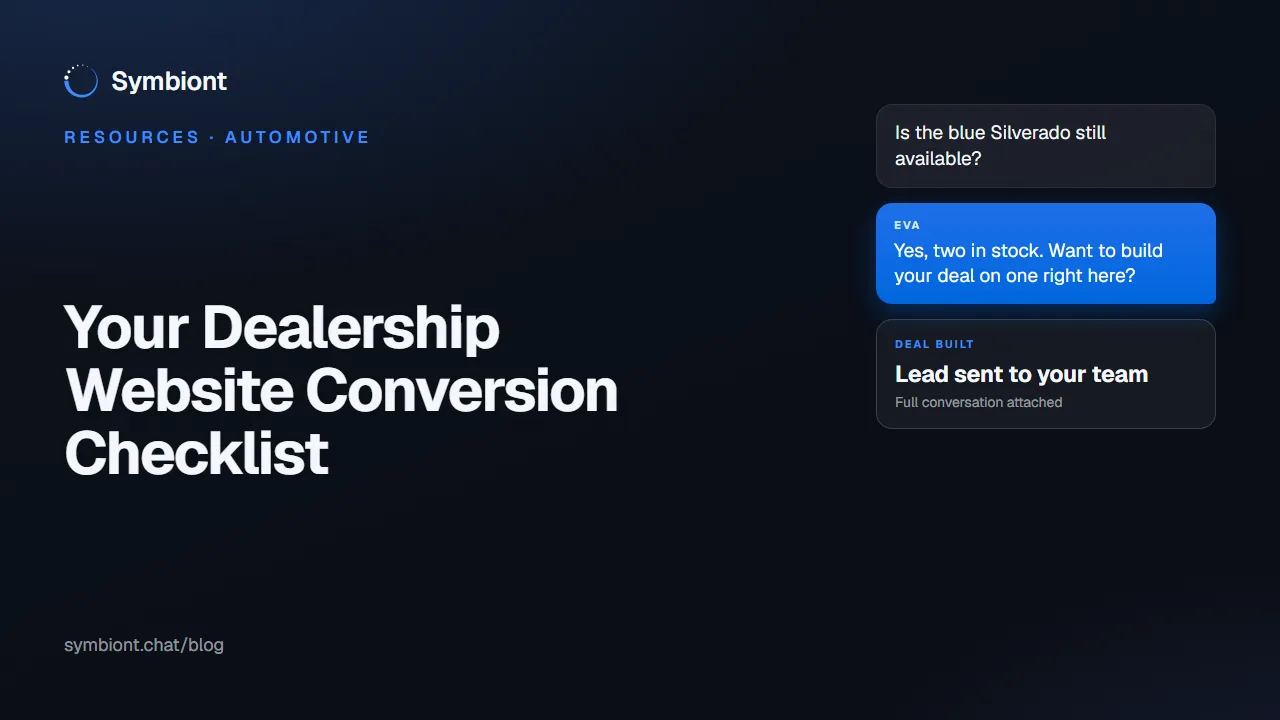
Run your dealership website against ten fixes, in payoff order: answer the shopper on the page, make the inventory searchable the way people talk, give every vehicle page a next step that is not a form, capture the trade, take test-drive and service requests, load fast on a phone, work every lead within the hour, and measure leads against total visitors.
I ran dealership operations for nine years, and every website review I sat in started with traffic and ended with a redesign. This list starts where the money is: the shopper is already on your VDP. Why that shopper leaves is the job of why your dealership website gets traffic but no leads, and what a good rate looks like belongs to the conversion rate benchmarks. This checklist stays on the fixes, in rough order of payoff.
1. Answer the shopper on the page, in seconds, at any hour
The first leak is silence. Pied Piper's 2026 Internet Lead Effectiveness study mystery-shopped 3,290 dealership websites and found 14% still failed to respond personally to their own web customers, and Foureyes' 2026 benchmarks put 62.8% of sales leads without a salesperson's reply 24 hours after returning to the site. The fix on this checklist is narrower than a BDC overhaul: the shopper who asks "is the blue Silverado still available?" at 9 p.m. gets a real answer while the page is open. What happens after a lead exists is speed to lead; when those leads actually arrive is the after-hours window.
2. Make the inventory searchable the way shoppers talk
Cox Automotive's 2025 Car Buyer Journey Study found 71% of buyers started with an open mind about what they would buy and visited 4.6 sites on average. A filter panel is built for the 29% who already know what they want. Let the other 71% type "something like a Tahoe but cheaper" or "under $400 a month with third-row seating" and get matches with live counts, narrowing one question at a time. Search is the funnel's front door; how a search turns into a compare, a deal, or a test-drive request is covered in conversational inventory search.
3. Replace the payment calculator with a deal the shopper builds
A payment calculator answers the shopper's biggest question and captures nothing. Cox's 2025 summary deck, drawing on its Car Buyer Journey and Digitization of Automotive Retail studies, shows 42% of buyers calculated a monthly payment online while 47% wanted to, and 37% wanted to finalize the price online while only 19% did. Give the VDP a deal builder instead: down payment, term, lease or finance, on the exact vehicle, with an email or phone number left to get pricing. That is a named lead carrying a structured deal, not an anonymous calculation. The psychology behind it is in why car buyers would rather build the deal themselves.
4. Capture the trade-in on the site, not at the desk
The trade is the strongest intent signal a visitor gives and the one most dealer sites bury under a long form. Kelley Blue Book's dealer page on Cox's 2025 buyer data says 72% of consumers who trade in at a dealership use KBB, which means most of your shoppers already valued the car before they reached your site. Meet them there: let them scan the trade with their phone camera and put it into the deal they are building, so the lead arrives with the trade attached. The full treatment, including instant cash offers and where trade leads go wrong, is in trade-in lead capture.
5. Take the test-drive request with a day and time
"Schedule a test drive" forms are abandoned because they ask for a phone number before offering anything back. Let the shopper pick a day and a time inside the conversation, and have that request reach your team as a lead with the conversation attached, so the confirming call is a confirmation and not a cold start. Nothing is written to a live calendar; your team confirms or moves it. The category and the honest limits are in test drive scheduling software for car dealerships.
6. Give the service tab its own conversion path
Service is the tab most dealer sites treat as a phone number, and it is where the loyalty leaks. Cox Automotive's 2025 Service Industry Study of 1,974 vehicle owners found dealerships handle 12% fewer service visits than in 2018, only 54% of owners with cars two years old or newer went back to the selling dealership for service (down from 72% in 2023), and owners who service at the dealership are far more likely, 74%, to buy their next car there. The same study's deck shows 71% of owners rate scheduling a service visit online as important, while only 35% have done it; that gap is the opportunity. So the service page needs what the sales page needs: an answer to "how much is a brake job" and a way to request an appointment, day and time included, without a phone call.
7. Answer in the shopper's language
A translated page is not an answered question. If a shopper writes in Spanish, the answer, the search, the deal, and the test-drive request should all happen in Spanish, and the handoff should reach whoever on your floor can continue it. Eva by Symbiont answers in 50+ languages, Spanish included. What that means on a real dealer site, and how big the audience is, is in selling to Spanish-speaking car buyers on your website.
8. Make it fast on a phone
Every fix above dies on a slow page. Google's mobile speed benchmarks, published in February 2017 (its 53% figure rests on March 2016 Google Analytics data), found 53% of mobile visitors leave a page that takes longer than three seconds, that the probability of a bounce rises 113% as load time goes from one second to seven, and that automotive was among the slowest sectors measured. The bar has since been written down: Google's Core Web Vitals call for a Largest Contentful Paint of 2.5 seconds or less and an Interaction to Next Paint at or under 200 milliseconds, at the 75th percentile, on mobile and desktop alike. Contentsquare's 2026 benchmark still measures desktop conversion 74% higher than mobile, which is the size of the gap a heavy VDP is paying for.
9. Work every lead within the hour, and log every one
Foureyes' 2026 report found 42.7% of qualified leads were mishandled and 15.2% were never logged to the CRM at all, while 61.2% of the leads that end up buying close within three days of the first website inquiry. Its companion study puts the average new vehicle at 3.3 leads to sell. A website fix that produces leads nobody works is a more expensive way to lose the same shopper. The checklist item is a process, not a tool: every website lead is in the CRM the moment it exists, and the first personal reply lands inside the hour. The cost of missing that window is quantified in dealership internet lead response time.
10. Measure leads against total visitors, with a written definition
Count leads divided by total unique visitors, decide in writing what counts as a lead, and hold every vendor to that denominator. Chats, opens, and engagements are not leads; a built deal, an emailed comparison, and a test-drive request are. What the public benchmarks measure and how to build your own is the job of the conversion rate benchmarks post, and the three questions that expose a vendor's inflated number are in how to audit dealer chat vendor claims. On this list, the box to tick is that the number exists and everyone in the building can say what it is.
Which of these does Eva by Symbiont handle on a dealership website?
Items 1 through 7, in one conversation on the pages the shopper is already reading. Symbiont is an AI chatbot and visual conversion system. Chat is the front door, not the whole product. Eva answers in seconds at any hour, in 50+ languages; runs an inventory search that reads the shopper's meaning with live match counts; puts Build My Deal on the vehicle page and in the chat; scans the trade-in with the phone camera; captures the test-drive request and the service request, day and time included; and captures every lead with the full conversation attached for your team. At Coast Buick GMC, a dealership we serve, Symbiont adds about half a point to a point of website lead conversion on top of what the store's forms already produce, measured against total unique visitors, with about 8 in 10 of those leads arriving through Build My Deal and the average buyer spending over five and a half minutes building the deal. Your existing forms keep working exactly as they do today. Items 8 through 10 stay yours: the page speed, the process, and the measurement. Everything she does for dealerships is on the Symbiont for automotive page.


The pools version of this list, with the fixes that are specific to a pool builder's site, is the pool website conversion checklist.
Frequently asked questions
What is a dealership website conversion checklist?
A short list of fixes that raise the share of your website visitors who become leads without buying more traffic: instant answers, conversational inventory search, a deal builder on the VDP, trade-in capture, test-drive and service requests, the shopper's language, mobile speed, lead handling, and measurement against total visitors.
Which fix should a dealership do first?
Answering on the page, at any hour, then giving the VDP a next step that is not a form. Those two plug the biggest leaks: the shopper who asks a question at night and hears nothing, and the shopper who would have built a deal but was offered a contact form instead.
Do I have to remove the contact forms from my dealership website?
No. Keep every form for the shoppers who prefer them and add the conversation and the deal builder alongside. Symbiont does not re-route the leads your forms already get; it converts the shoppers who would have left without submitting one. The leads it adds are measured on top of the forms, not instead of them.
Should the service department have its own conversion path?
Yes. Service visits are where dealerships have lost ground since 2018 and where the next sale is won: owners who service at the dealership are far more likely to buy there again. A service page that answers cost questions and captures an appointment request, day and time included, keeps that owner instead of sending them to a phone tree.
How do I know the checklist is working?
Leads divided by total unique visitors goes up while traffic stays flat, and a growing share of those leads arrive with something attached: a built deal, a trade, a test-drive or service request. If the rate does not move, the leak is usually the follow-up: check CRM logging and first-reply time before touching the site again.
Run the list on your own site
The fastest way to score your site against this list is to watch a shopper get answered, search the inventory, and build a deal on it. Get a demo and see Eva do the first seven items on your own inventory.
Which of the ten did your website fail at 9 p.m. last night?