Automotive
Conversational Inventory Search: How Car Shoppers Actually Search a Dealer Website
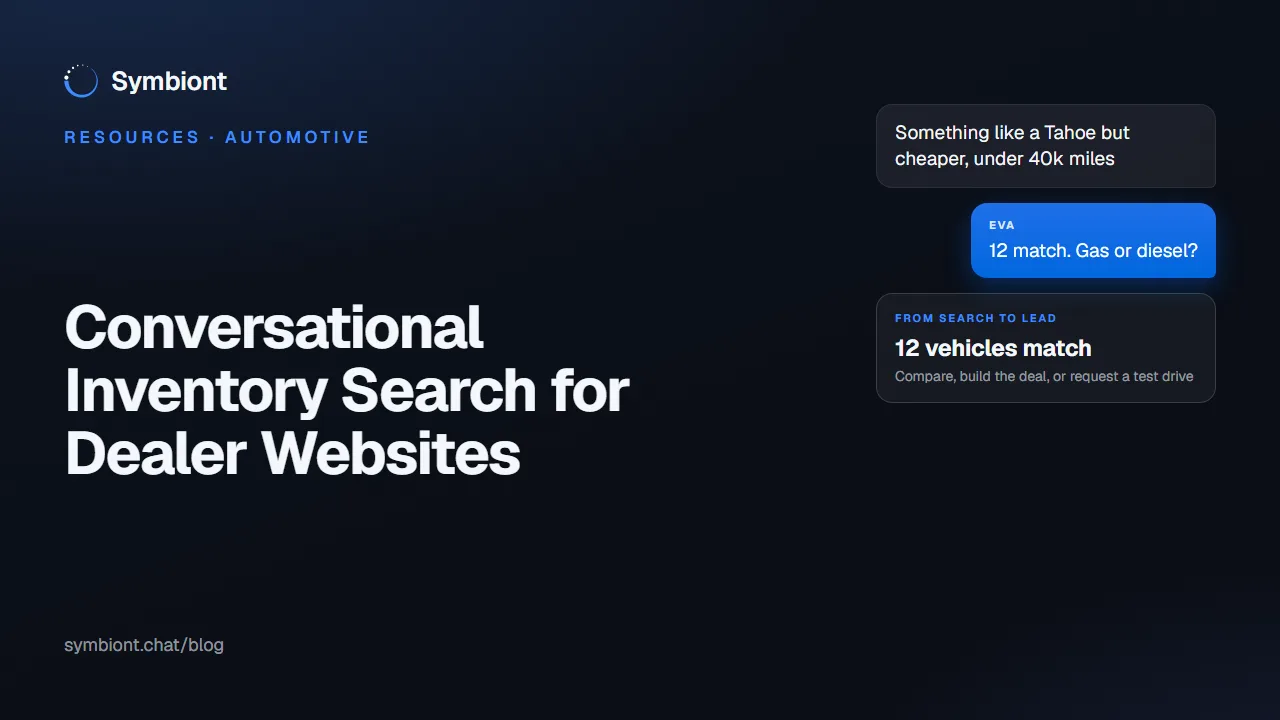
Conversational inventory search lets a shopper describe the vehicle they want in plain language, or by voice, and get matching vehicles back with live counts instead of a wall of filters. On a dealership website it does two jobs at once: it answers the search faster than a filter panel can, and it turns the search itself into a lead.
I ran dealership operations for nine years before co-founding Symbiont, and the inventory page was the part of the website I understood least. We spent real money getting people to it, and the analytics said most of them left from it. It took a long time to accept that the page was not slow or ugly. It was asking questions the shopper could not answer yet.
Why do filter panels lose shoppers?
Because most shoppers arrive undecided, and a filter panel only works for people who have already decided. Cox Automotive's 2025 Car Buyer Journey Study, a survey of 2,300 recent buyers, found that 71% went into the process with an open mind about what they would buy, and 66% considered both new and used. Those shoppers do not have a make, model, trim, and price band ready to click. They have a sentence: something roomy for two car seats, under a certain payment, not white.
A filter panel cannot take a sentence. So the open-minded shopper picks a few boxes, gets forty results or zero, and leaves for the next site. The same study puts the average buyer on 4.6 websites during the process, with 59% visiting a dealership site. Your inventory page is one stop on a tour, and the tour continues the moment the page makes the shopper do the work.
What does a conversational search do with "something like a Tahoe but cheaper"?
It reads the intent, not the keywords, and it answers in the shape the request came in. A specific request ("a 2023 Silverado 1500 with the towing package") returns the matches plus the closest comparables, so a near miss is not a dead end. A broad request ("something like a Tahoe but cheaper") returns a set, then narrows it the way a good salesperson would: by the one criterion that cuts the list fastest, with a live count next to each choice so the shopper always knows how many vehicles are left. Gasoline or diesel, 54 or 12. Under 40,000 miles, 12 or 5.
The narrowing happens in the conversation, not on a separate results page, so the shopper never loses the thread. Compound questions work ("a truck I can tow a boat with that my wife will also drive to work"), and so does the slang shoppers actually use. Because the request is understood rather than matched, it works in 50+ languages, Spanish included, without a translated copy of the inventory page.
How does a search become a lead?
Because the search reveals intent, and the next step is one tap away inside the same conversation. From a result the shopper can compare the vehicles they are cross-shopping on the metrics they care about and have the comparison emailed to them, which is a captured lead. They can open Build My Deal from the vehicle card, pick a down payment and term, scan their trade-in with the phone camera, and leave an email or phone number to get pricing. Or they can pick a day and time for a test drive, which reaches your team as a request, day and time included, with the whole conversation attached.
None of that requires a form first. That is the difference between a search tool and a lead tool: a filter panel ends at a vehicle detail page, and a conversational search ends at a deal, a comparison, or a request your desk can work.
Eva by Symbiont runs this search on the dealership's own website, where the shoppers already are. Symbiont is an AI chatbot and visual conversion system. Chat is the front door, not the whole product. Eva engages the anonymous shopper on the inventory they are looking at, narrows it with live match counts, and captures the shoppers your website would have lost, in 50+ languages. At Coast Buick GMC, a dealership we serve, Symbiont adds about half a point to a point of website lead conversion on top of what the store's forms already produce, and about 8 in 10 of those leads arrive through Build My Deal, with the average buyer spending over five and a half minutes building the deal. The search is where most of those conversations start. Everything she does for dealerships is on the Symbiont for automotive page.


How does Eva turn a miss into a match?
The zero-results page is where a dealership website loses its most specific shoppers: someone who can describe exactly what they want gets told the lot has nothing. Eva treats that moment as the middle of the search, not the end. Before a shopper is told no, she keeps working, and when criteria have to give, a 12-tier ladder relaxes the least important ones first. A color or a wheel size goes long before anything that matters, and make, model, body style, and powertrain are never dropped at all. The shopper sees what was relaxed and what still applies, so the result reads as an honest answer instead of a bait and switch.
The same discipline applies when a search comes back thin. At 4 or fewer results, Eva keeps the real matches on top and adds exactly 3 close alternatives beneath them, ranked by closeness. 15 vehicle attributes are protected while she broadens: a diesel shopper never gets a gasoline suggestion, and nobody who asked for AWD is shown a rear-wheel-drive alternative. Suggested price and mileage ranges come from vehicles actually in stock, so "15 trucks between 60k and 80k" is a fact about the lot, not a formula. And when the shopper knows exactly what they want, a VIN or stock number returns that vehicle, immediately.
Behind the plain sentence sits a parser that fills 71 structured fields and 88 named vehicle features. Slang, abbreviations, typos, broken words, and backwards price bounds are repaired before the search runs, terms that mean the same thing resolve to one filter, and a superlative like "cheapest" or "most towing" returns a sorted top 10 instead of a filter. When a request cannot be expressed as filters at all, semantic vector search returns the closest vehicles in stock with the shopper's hard requirements still applied. The full capability specs live on the Symbiont for automotive page.
Does voice search matter on a dealership website?
More than most dealers expect, because a phone is where a large share of inventory browsing happens and typing a sentence on a phone is a chore. Voice removes the chore: the shopper says what they want and the search treats it exactly like a typed request, with the same narrowing and the same live counts.
The appetite for this kind of tool is not hypothetical. In the same Cox study, 19% of all buyers, and 25% of new-vehicle buyers, used AI websites such as ChatGPT or AI-generated search overviews during their purchase, and 84% of the mostly-digital buyers who engaged an AI assistant reported high satisfaction. Buyers are not asking whether a website can understand them. They are noticing which ones do.
What should a dealer check before buying a search tool?
Five things, in this order:
- Live inventory. The search has to run on what is on the lot today, including pricing and photos, or the first wrong answer costs the shopper's trust. Symbiont goes live in 48 hours with real-time inventory updates and no complex DMS integration required.
- Narrowing quality. Ask the vendor to show a broad request and a specific one. Watch whether the tool asks the fastest-narrowing question next or just dumps results.
- Live counts. A shopper who can see "12 left" keeps going. One who cannot, stops.
- The next step. Compare, build the deal, request the test drive: all of it should happen from the result, inside the conversation, without a form first.
- The measurement. Count leads against total website visitors, never against chats. The audit of dealer chat vendor claims shows how to ask for that number, and the case study of a store that reports it honestly shows what that number looks like in practice.
If the shopper can search the way they talk, the search stops being a filter and starts being the first ten seconds of a sale. For where a tool like this fits among managed chat and AI assistants, the map of dealership live chat software lays out the categories, and for the wider comparison the best AI chatbot for car dealerships guide names the real alternatives.
FAQ
Is conversational inventory search just a chatbot with a search box?
No. A chatbot answers questions; a conversational search runs the inventory query itself, returns matches with live counts, narrows by the criterion that cuts the list fastest, and leads straight into a comparison, a deal, or a test-drive request. The chat window is the interface, not the product.
Does a conversational search need my inventory feed rebuilt?
No. It runs on the live inventory data the website already uses, including pricing, photos, and specs, and it stays current as vehicles arrive and sell. Symbiont goes live in 48 hours with real-time inventory updates and no complex DMS integration required.
Can shoppers search by voice on a phone?
Yes. A spoken request is treated exactly like a typed one: the same intent reading, the same narrowing, the same live counts. On a phone, where typing a full sentence is a chore, voice is often the faster way in, and the answer stays in the conversation.
What happens when the shopper's request matches nothing on the lot?
A good search returns the closest comparables rather than an empty page, then keeps narrowing from there. The shopper who wanted a specific trim you do not have still sees the two vehicles you do have that fit, and can compare them or request a test drive without starting over.
How do I know the search is producing leads and not just conversations?
Count leads against total website visitors, with the definition of a lead written down. A search that produces comparisons, built deals, and test-drive requests will show up in that number; a search that only produces chats will not. The vendor-claims audit covers the questions to ask.
See it run on your own inventory. Get a Demo or call 941-404-5402.