Automotive
Why Car Buyers Would Rather Build the Deal Themselves
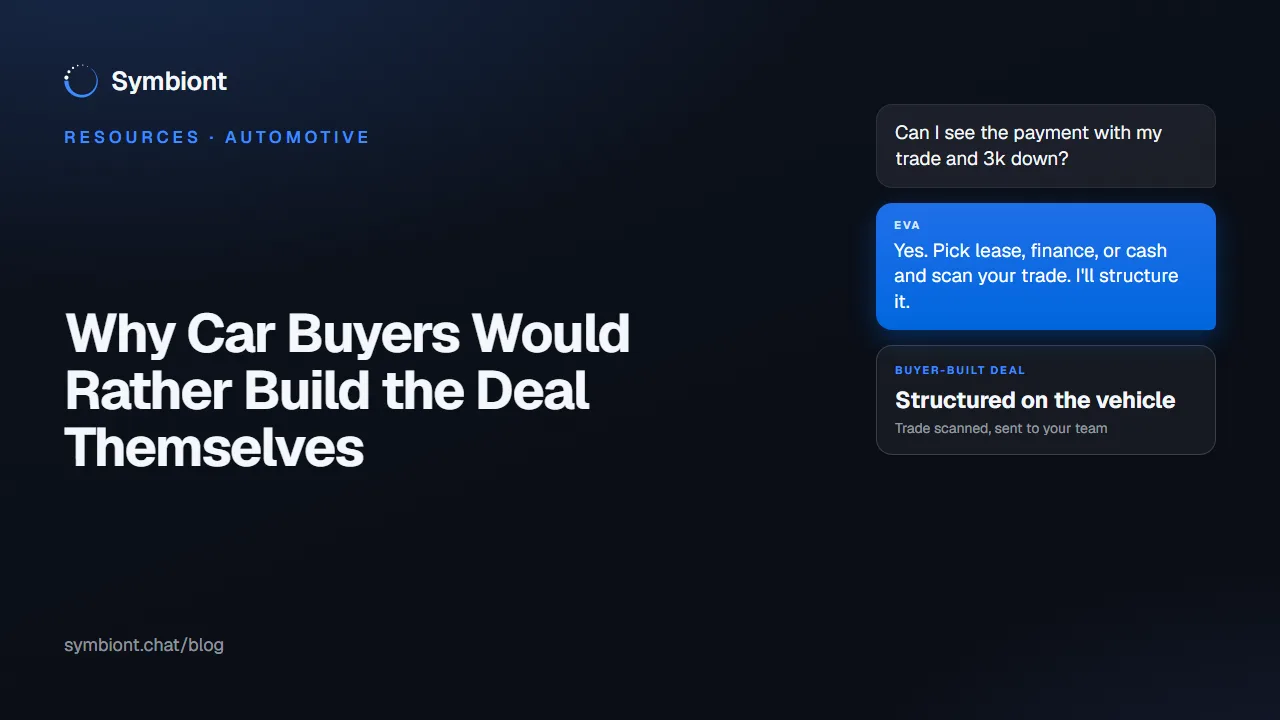
Car buyers want to build their own deal online because the numbers are the part of the purchase they most want to control and least want to negotiate blind. Most still want to finish with a person. A deal they structure on your website, on the exact vehicle, is the middle they are asking for.
I spent nine years in dealership operations, most of it watching the same handoff fail. A shopper did real work on the website at night, arrived the next day, and started over at the desk because nothing they had done carried forward. What they had wanted was never to skip the desk. It was to arrive at it knowing the numbers.
What do buyers actually want to do online?
Work the deal, not sign it. Cox Automotive's 2025 Car Buyer Journey Study, a survey of 2,300 recent buyers, found that 53% completed every step at the dealership and only 7% bought entirely online. Asked what they would prefer, 63% chose an omnichannel process and 28% wanted to buy fully online. The same study found 71% started out with an open mind about what they would buy.
Read those together and the buyer is clear about what they want: to research and structure on their own time, and to close with a person. The website that serves that buyer is not a checkout. It is a place to build the deal.
Why the numbers, specifically?
Because the payment is the decision. A shopper can fall for a vehicle in the photos, but they commit to a monthly number, and they want to know it before anyone is watching them react to it. Down payment, term, lease against finance against cash, and what the trade is worth: those are the levers, and a shopper who can move them privately arrives at the desk having already made peace with a range.
The industry has been slow to give them that, and it shows in the data. Cox's Digitization of Automotive Retail Study, released in June 2025, reports that 7 in 10 buyers say completing steps online saves time and improves their experience, while 83% of dealers acknowledge customers often repeat steps in store because of inconsistent online data, and 62% of dealers run multiple retailing tools. Nearly half of franchise dealers now offer a fully online purchase experience, double the share of two years earlier. The tools multiplied; the carry-forward did not improve.
What does a deal builder give them that a payment calculator does not?
The exact vehicle, the whole structure, and a next step. A payment calculator takes a price and a rate and returns a number the shopper cannot act on. A deal builder opens from a banner on the vehicle page, or from the same vehicle inside a chat, and lets the shopper choose lease, finance, or cash, a down payment, and a term, scan their trade-in's barcode with the phone camera, and see taxes and fees calculated on the structure they chose.
Then the step that makes it a lead rather than a calculator: to get pricing, the shopper leaves an email or phone number, and the deal they built arrives to your team and your CRM with the vehicle and the conversation attached. No form first. That is why the shoppers who use it are the ones a form would never have captured.
It is also not digital retailing, and that is deliberate. Full-checkout platforms aim at the entire transaction online, from credit to contracts, which the 7% did. A deal builder serves the 63% who said an omnichannel process, online and in-store combined, would be ideal.
Why does a deal the buyer built convert better than a form?
Because it is evidence of intent, and it arrives with the numbers already in it. A form tells you someone was willing to be contacted. A built deal tells you the vehicle, the payment type, the down payment, the term, and the trade, and it tells you the shopper spent minutes on it. Your desk opens a conversation that is most of the way to a decision.
At Coast Buick GMC, a dealership we serve, Symbiont adds about half a point to a point of website lead conversion on top of what the store's forms already produce, measured against total site traffic, and about 8 in 10 of those leads arrive through Build My Deal, with the average buyer spending over five and a half minutes building the deal. Those figures come from the dashboard the store logs into, and the case study walks through where each one comes from. Chat on its own does not do this. Shoppers will not talk to an AI for long, but they will build a deal.
Eva by Symbiont puts Build My Deal on the dealership's own website, on every vehicle page and inside the chat, alongside the conversational inventory search that gets shoppers to the right vehicle in the first place. Symbiont is an AI chatbot and visual conversion system. Chat is the front door, not the whole product. It engages the shopper on the vehicle they are looking at and captures the shoppers your website would have lost, in 50+ languages. What she does for dealerships end to end is on the Symbiont for automotive page.


What happens after they build it?
The deal reaches your team with the shopper's numbers and the whole conversation attached, and your desk confirms the pricing with a person. If the shopper also picked a day and time for a test drive, that request arrives the same way, day and time included; nothing is written to a live scheduler, your team confirms it or moves it. Speed still decides the outcome. Foureyes' 2026 Automotive Dealer Benchmarks Report, built on 1.4 billion dealer website visits across more than 22,900 dealership websites in 2025, found that, among the sales leads that end up buying, 61.2% close within three days of their initial website inquiry. A built deal is the warmest version of that inquiry, and it deserves the fastest reply your store can give. The speed to lead for car dealerships guide covers what that reply should look like.
What should a dealer check before adding a deal builder?
Five things:
- Both entry points. The builder should open from the vehicle page and from inside the chat, so a shopper who arrived through a conversation does not have to leave it to build the deal.
- Trade-in on the spot. A barcode scan with the phone camera keeps the trade inside the structure instead of turning it into a second negotiation.
- The whole structure. Lease, finance, or cash, with taxes and fees calculated, so the shopper is working real numbers.
- Where the deal lands. Into your CRM, with the conversation, so the salesperson picks up where the shopper left off rather than starting over.
- The measurement. Ask for leads against total website visitors and what share arrived with a built deal. The audit of dealer chat vendor claims lists the questions that expose a vanity number.
Pricing follows the same pattern as most dealership software: quotes rather than public rates. Symbiont's pricing depends on your store's setup and is covered in a short demo rather than posted publicly. It runs month to month, with no contracts, no setup fees, and no credit card to start, and most stores are live within 48 hours, with real-time inventory updates and no complex DMS integration required. For how it sits beside the other tools dealers consider, the best AI chatbot for car dealerships guide names the alternatives and the criteria.
FAQ
Do car buyers really want to buy a car entirely online?
Few do. Cox Automotive's 2025 Car Buyer Journey Study found 7% bought entirely online and 28% would prefer to, while 63% said an omnichannel process, online and in-store combined, would be ideal. Buyers want to structure the deal themselves; most still want a person in the loop.
What is the difference between a deal builder and digital retailing?
Scope. Digital retailing platforms aim at the full transaction online, from credit to contracts. A deal builder covers the structuring step: vehicle, payment type, down payment, term, and trade, then contact details to get pricing. The shopper builds on the website and your desk finalizes with a person.
Does the shopper see final pricing inside the deal builder?
The builder structures the deal and calculates taxes and fees on the choices the shopper made. To get pricing, the shopper leaves an email or phone number, and your desk confirms the numbers with them. That exchange is the lead, and it arrives with the structure already attached.
Can a shopper include their trade-in?
Yes. The shopper scans the trade-in's barcode with their phone camera from inside Build My Deal, so the trade is part of the structure the shopper sends rather than a separate conversation your team has to start later. No appraisal form, no photos to email.
How long does it take to add a deal builder to a dealership website?
Most stores are live within 48 hours, on the website they already have, with real-time inventory updates and no complex DMS integration required. The builder appears on vehicle pages and inside the chat from day one, and pricing is covered in a short demo.
See a shopper build a deal on your own inventory. Get a demo or call 941-404-5402.