Automotive
Why Your Dealership Website Gets Traffic but No Leads
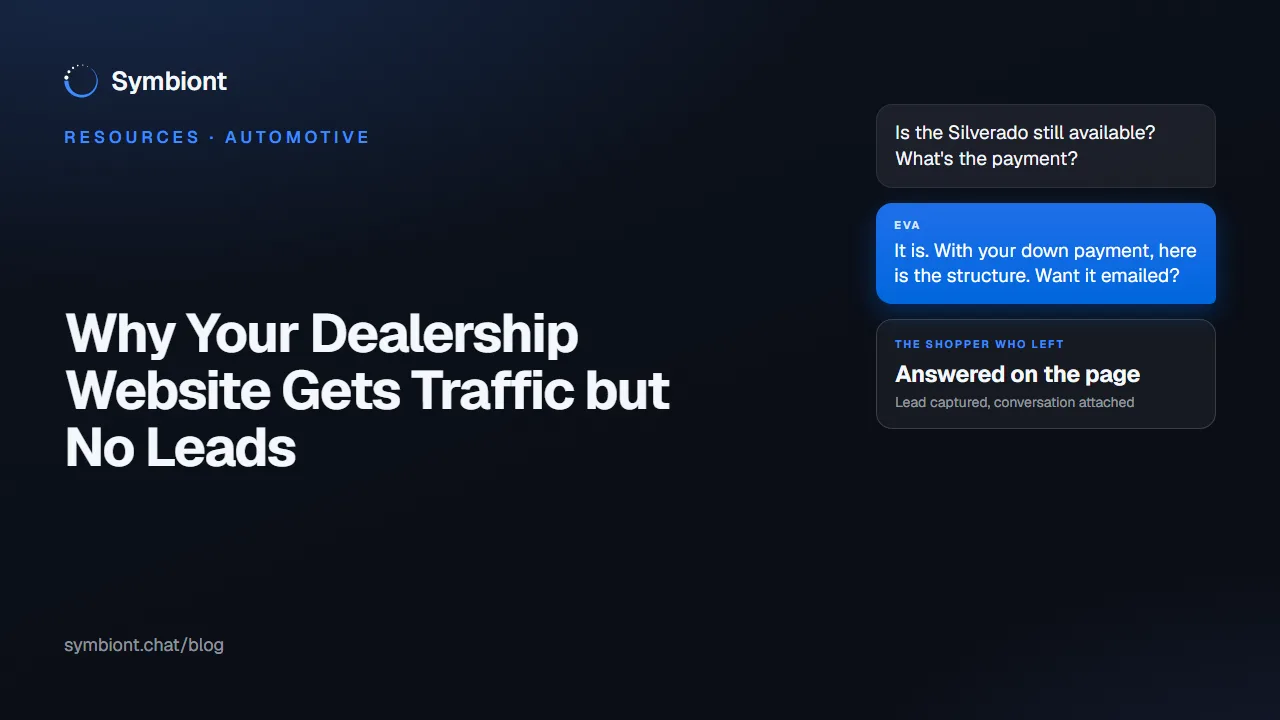
Your dealership website gets traffic but no leads because most shoppers arrive undecided, compare several stores in one sitting, and leave the moment a site asks them to commit to a form. Fixing it means answering them while they are still on the page, not buying more of them.
I spent nine years in dealership operations before co-founding Symbiont, and I signed off on plenty of marketing spend that bought exactly what it promised: visits. The visits came. The leads did not move. Nobody in the building could say where the visitors went, so we bought more of them.
Is it really a lead problem and not a traffic problem?
Almost always, and the shopper data explains why. Cox Automotive's 2025 Car Buyer Journey Study, a survey of 2,300 recent buyers, found that buyers visited 4.6 websites on average, that 59% visited a dealership's site, and that 71% started the process with an open mind about what they would buy. The traffic is there. It is undecided, it is comparing, and it is not ready to fill out a form on the first visit to your inventory.
For what happens next, the widest measurement is Contentsquare's Digital Experience Benchmark, drawn from 99 billion sessions: new-visitor conversion of 1.7%. That is an all-industry web figure, not a dealership one, so treat it as the shape of the problem rather than your number. The shape is that roughly 98 of every 100 first-time visits end without a conversion.
Where do the visitors actually go?
To the next store. The same Cox study puts 75% of buyers on third-party sites and 59% on dealership sites, which means your inventory page is one stop on a tour that spans several sites in one sitting. Shoppers are not leaving the market when they leave your site. They are continuing the comparison somewhere that answered them.
That is the part that stings, because the answer they wanted was usually simple: is it still available, what is the payment with this much down, do you take my trade, can I see it Saturday. A store that answers those questions on the page keeps the shopper on the page. A store that answers with a form sends them to the next tab.
What does the form do to a shopper who is not ready?
It asks for commitment before it gives value. A form says: tell us who you are and we will get back to you. To a shopper who has not decided on a vehicle, let alone a store, that is a bad trade, so they decline it, silently, by leaving. And the decline is invisible in your analytics, which show a visit and nothing else.
The timing makes it worse. A large share of that research happens at night and on weekends, when nobody is staffing the inbox anyway. The after-hours window for dealership leads lays out when shoppers actually shop versus when the BDC is on the clock. The visitors you are losing are disproportionately the ones shopping alone, on a phone, after close.
What happens to the leads you do get?
The leak continues after the form. Foureyes' 2026 Automotive Dealer Benchmarks Report, built on 1.4 billion dealer website visits across more than 22,900 dealership websites in 2025, found that 42.7% of qualified leads were mishandled and 15.2% were never logged to the CRM at all. And 62.8% of sales leads had not heard back from a salesperson within 24 hours of returning to the dealer's site. The window is short: among the sales leads that end up buying, 61.2% close within three days of the initial website inquiry.
So the store that gets few leads also loses a large share of the ones it gets, and the shopper who was ignored for a day is buying somewhere else by day three. The dealership internet lead response time data goes deeper on the cost of that delay, and speed to lead for car dealerships covers the fix on the follow-up side.
How do you turn the traffic into leads without more spend?
Give the undecided shopper something to do on the page besides fill out a form. Let them search the inventory the way they talk and narrow it with live counts, as conversational inventory search does. Let them compare the vehicles they are cross-shopping and get the comparison emailed, which is a lead. Let them build the deal on the exact vehicle, with a down payment, a term, and a trade-in scanned with their phone, and leave an email or phone number to get pricing. Let them pick a day and time for a test drive and have the request reach your team with the conversation attached.
That is the work Eva by Symbiont does on a dealership's website. Symbiont is an AI chatbot and visual conversion system. Chat is the front door, not the whole product. It engages the shopper on the inventory they are looking at, in 50+ languages, and captures the shoppers your website would have lost. At Coast Buick GMC, a dealership we serve, Symbiont adds about half a point to a point of website lead conversion on top of what the store's forms already produce, measured against total site traffic, and about 8 in 10 of those leads arrive through Build My Deal, with the average buyer spending over five and a half minutes building the deal. The forms keep working exactly as before. These are the shoppers who would have left. Everything she does for dealerships is on the Symbiont for automotive page.


How do you measure it honestly?
Count leads against total website visitors, with the definition of a lead written down, and ask what share of them arrived with something attached: a comparison, a built deal, a test-drive request. Never count chats, opens, or engagements. A vendor whose number cannot be expressed against your total traffic is describing activity, not leads. The audit of dealer chat vendor claims gives you the three questions, and the case study shows a store reporting the number that way.
FAQ
How much of a dealership's website traffic normally becomes a lead?
There is no dealership-specific benchmark worth trusting, and the broad web figure from Contentsquare, 1.7% of new visitors, is an all-industry number, not a dealership one. What you can measure is your own number: leads divided by total unique visitors, with a written definition of a lead. That is the figure to improve and the one to hold vendors to.
Do I need more traffic or better conversion?
If your visits are steady and your leads are flat, conversion. More traffic multiplies the same leak. Cox's 2025 study has buyers visiting 4.6 sites and 71% arriving undecided, so the visitors are already on your site; the question is whether the site answers them before they move to the next one.
Why do shoppers leave a dealership website without submitting a form?
Because the form asks for commitment before giving anything back. An undecided shopper who wants to know the payment on this truck with this much down, or whether you take their trade, gets a request for their phone number instead of an answer, and leaves for a site that answers.
Does adding a chat widget fix it?
Not on its own. Chat alone does not convert dealership traffic; shoppers will not talk to an AI for long. What converts is the next step inside the conversation: a comparison they can have emailed, a deal they build on the vehicle, a test-drive request with a day and time. Those are leads. A chat window is a place to start them.
What is the first thing to fix?
Answer the shopper while they are on the page, at any hour, and give them a next step that does not begin with a form. Then fix the follow-up: a built deal or a test-drive request that waits a day for a reply is a lead your store is handing to the next store.
See what your traffic is already worth. Get a demo or call 941-404-5402.